
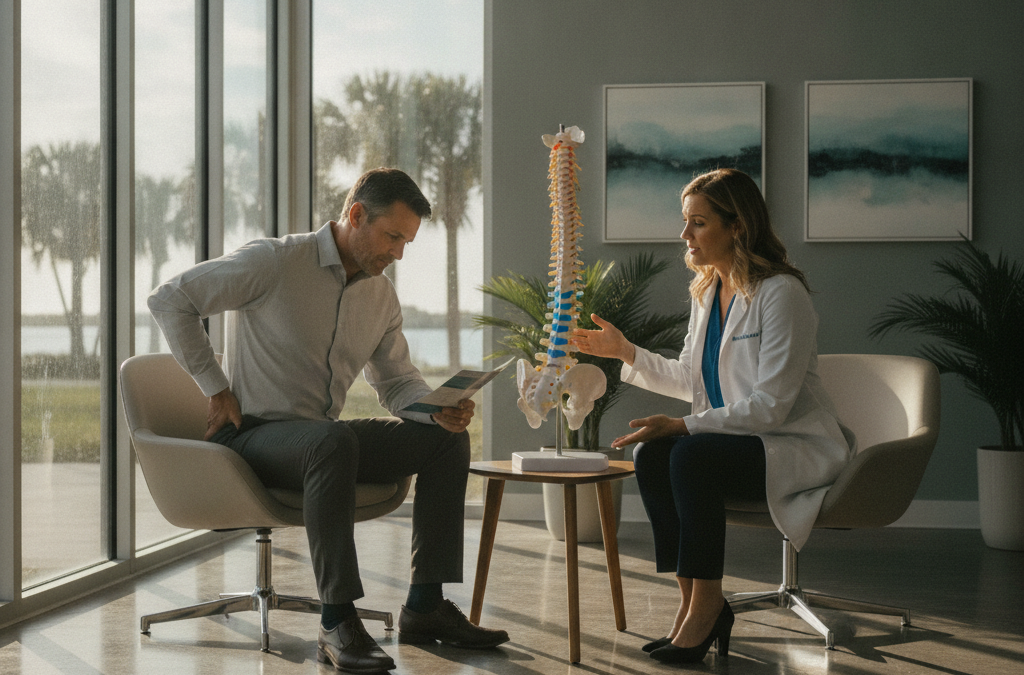
What Is Discogenic Pain — and Why Are So Many Patients in Brandon and Riverview Living With Chronic Back Pain That Injections and Physical Therapy Haven’t Fixed?
If you’ve been dealing with persistent low back pain in Brandon or Riverview — pain that hasn’t responded to physical therapy, hasn’t gone away with anti-inflammatories, and hasn’t been fully explained by your MRI — there’s a real possibility that the source is something called discogenic pain. It’s one of the most common yet most frequently overlooked causes of chronic back pain, and it requires a specific diagnostic approach to identify and treat correctly. Without that precision, patients often cycle through generic treatments for months or years without meaningful relief.
What Exactly Is Discogenic Pain?
Your intervertebral discs are the shock-absorbing cushions that sit between each vertebra in your spine. Each disc has a tough outer shell called the annulus fibrosus and a gel-like inner core called the nucleus pulposus. Discogenic pain occurs when the disc itself becomes a source of pain — not because it’s pressing on a nerve root (that’s a herniation), but because the disc’s internal structure has broken down or developed tears that sensitize the nerve fibers running through the outer disc wall.
This distinction matters enormously for treatment. A nerve root compression responds differently to injections and therapy than an internally deranged disc. When that distinction isn’t made, treatment often misses the target entirely.
Discogenic pain typically presents as:
- Deep, aching low back pain that’s difficult to localize to one spot
- Pain that worsens with prolonged sitting, bending forward, or loading the spine
- Pain that may radiate into the buttocks or upper thighs — but not as sharply as classic sciatica
- Stiffness after periods of rest that loosens with movement, then worsens again with sustained activity
- Symptoms that don’t fully match what’s visible on a standard MRI
That last point is where many patients get stuck. A routine MRI can show disc degeneration or a mild bulge and be read as “mild” or “age-appropriate” — but that reading doesn’t tell you whether that disc is actually generating your pain. Identifying discogenic pain as the true source requires clinical correlation by a physician experienced in spine diagnostics, not just imaging review in isolation.
Why Is This Condition So Frequently Missed — Especially After an Accident?
Discogenic pain is particularly common in patients who’ve been in motor vehicle accidents or experienced a significant fall. The force of impact — even in collisions that seem minor — can accelerate disc degeneration and cause annular tears that weren’t present before. For patients along the busy corridors of Hillsborough County, where high-volume highways and intersections contribute to one of Florida’s highest rates of accident-related injury claims, this is not an abstract concern. It’s a daily reality for patients sitting in pain right now.
The problem is that standard post-accident care pathways aren’t always set up to catch it. Emergency rooms rule out fractures and major structural damage. Follow-up primary care focuses on inflammation management. Physical therapy addresses muscular imbalances. All of that has value — but none of it specifically evaluates the disc as an independent pain generator. Months go by, the acute inflammation settles, and patients are left with chronic pain that everyone acknowledges but no one has precisely diagnosed.
This is a consistent gap in the care landscape for patients across the Tampa Bay area. Many of the spine and neurology clinics operating locally focus their content and clinical protocols on nerve compression and surgical candidacy — leaving patients with disc-sourced pain in a diagnostic no-man’s land. If you’re not a surgical candidate but you’re still in significant pain, you deserve a clearer answer than “keep doing PT.”
What a Proper Evaluation for Discogenic Pain Actually Involves
Getting to the right diagnosis takes more than an MRI report. A thorough evaluation should include a detailed clinical history — specifically when your pain is worst, what movements provoke or relieve it, and how it’s changed over time. The physical exam matters too: how your spine loads and unloads, where your pain localizes under pressure, and what neurological signs are present or absent.
Advanced neuroimaging interpretation — not just ordering an MRI but reading it in the context of your symptoms — is essential. At Advanced Brain & Spine, Dr. Saldin brings Duke-trained neurology and University of Virginia board-certified pain medicine expertise together with a specialization in neuroimaging. That combination allows for a level of diagnostic precision that goes well beyond what a general practitioner or a high-volume urgent care clinic can offer.
In some cases, a procedure called a provocative discography may be discussed to confirm which disc level is generating pain — though this is considered carefully and not applied universally. The goal is always the most accurate diagnosis with the least unnecessary intervention. You can learn more about the full range of spine care services available at our Tampa practice.
Treatment Options When the Disc Is the Problem
Once discogenic pain is properly identified, treatment options become more targeted. The right approach depends on the severity of disc breakdown, your overall health, how long you’ve been symptomatic, and how you’ve responded to prior treatments. Options may include:
- Targeted interventional procedures: Intradiscal injections or annuloplasty techniques directed at the disc itself — not just the surrounding nerve roots — can reduce inflammation and interrupt pain signaling more precisely than standard epidural injections.
- Regenerative approaches: For patients with early-to-moderate disc degeneration, regenerative therapies including stem cell therapy for back pain offer a way to support disc tissue healing and reduce chronic inflammation. These approaches are not a cure-all, but for appropriately selected patients, they represent a meaningful alternative to repeat injections or jumping to surgery.
- Structured rehabilitation with disc-specific protocols: Physical therapy is not wrong for discogenic pain — but the approach has to be tailored. Extension-based loading protocols differ significantly from flexion-based ones, and that matters when the disc is the target.
- Surgical evaluation when conservative care has failed: For patients with severe disc breakdown and persistent disability, surgical consultation may eventually be appropriate. But that conversation should happen after a proper diagnosis, not as the default when nothing else has been tried correctly.
Who in Brandon, Riverview, and South Tampa Should Be Evaluated?
If you live in Brandon, Riverview, or surrounding Hillsborough County communities and any of the following applies to you, it may be time for a more targeted evaluation:
- You’ve had low back pain for more than three months with no clear resolution
- You’ve had an MRI that was described as “mild” or “unremarkable” but you’re still significantly limited by pain
- Epidural injections provided temporary relief but the pain keeps returning
- Your pain started after a car accident, slip-and-fall, or heavy physical impact
- You’re on lien-based care or working through a personal injury claim and need a specialist who can document and treat your injury accurately
- Physical therapy has helped your function but hasn’t meaningfully reduced your core pain level
This is not a list of worst-case scenarios. These are common presentations from patients throughout the Wesley Chapel, South Tampa, and greater Hillsborough County areas who simply haven’t had the right diagnostic conversation yet.
Frequently Asked Questions
Can discogenic pain show up on a regular MRI?
Sometimes — but not always reliably. An MRI can show disc degeneration, height loss, or signal changes, but it can’t always confirm that a particular disc is actively generating your pain. Clinical correlation by an experienced physician is essential to connect imaging findings to your actual symptoms.
Is discogenic pain the same as a herniated disc?
No. A herniated disc causes pain primarily by pressing on a nearby nerve root. Discogenic pain originates within the disc itself — from internal disruption and sensitized nerve fibers in the outer disc wall — and may not involve nerve compression at all. The distinction changes how treatment should be approached.
Will insurance cover evaluation and treatment for discogenic pain in Florida?
It depends on your coverage. Florida’s no-fault PIP insurance typically covers initial evaluation and some conservative treatment after a motor vehicle accident. Patients working through a personal injury claim may qualify for lien-based care, meaning treatment now with payment resolved at claim settlement. At Advanced Brain & Spine, we work with patients across a range of insurance situations and can help clarify what applies to your case during a consultation.
How long does it typically take to get a diagnosis and start treatment?
For most patients, a thorough initial evaluation can be completed in one or two visits. If additional diagnostic steps are needed — such as further imaging or a procedural evaluation — timelines vary. The important thing is not to let urgency push you toward a generic treatment plan before the correct diagnosis is established.
Is this condition common after car accidents, or is it more from general wear and tear?
Both. Discogenic pain can develop gradually from cumulative disc stress, but traumatic loading — as occurs in motor vehicle accidents, even lower-speed collisions — can accelerate the process significantly or cause acute annular tears in previously healthy discs. Patients injured on Tampa Bay roads who develop persistent back pain after an accident deserve evaluation specifically for this possibility.
You Deserve a Clear Answer, Not Another Round of Generic Treatment
Chronic back pain is not something you should simply manage indefinitely. If you’re in Brandon, Riverview, or anywhere across the Tampa Bay area and you haven’t gotten a precise explanation for why your pain persists — or a treatment plan that actually addresses that explanation — it’s worth seeking a second opinion from a specialist who can look at your case with fresh, experienced eyes.
At Advanced Brain & Spine, we approach spine pain diagnostics with the same thoroughness we apply to neurological conditions. The goal isn’t to offer you the next generic treatment on the list. It’s to understand exactly what’s causing your pain and build a plan around that. Contact us today to schedule a consultation and get the kind of personalized, precise evaluation your condition deserves.