
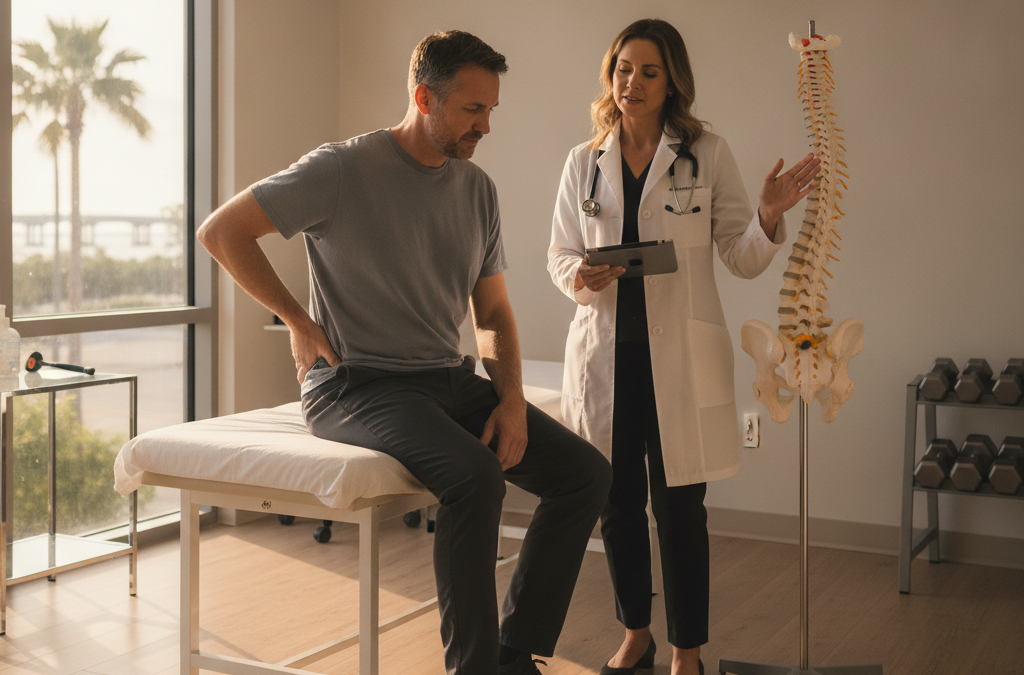
What Is Spinal Stenosis After a Car Accident — and Why Are So Many Patients in Clearwater and St. Petersburg Not Connecting Their Symptoms to Their Crash?
Yes — a car accident can absolutely cause or significantly worsen spinal stenosis, and if you’re a patient in Clearwater, St. Petersburg, or anywhere in the Tampa Bay area dealing with leg weakness, back pain that flares when you walk, or tingling that shoots down into your feet, your crash may be far more responsible than you realize. The frustrating truth is that spinal stenosis triggered or accelerated by trauma is one of the most commonly overlooked accident-related diagnoses in this region — and that gap in recognition can cost you months of unnecessary suffering and complicate your ability to document your injuries for an insurance or legal claim.
What Spinal Stenosis Actually Is — and What It Isn’t
Spinal stenosis is a narrowing of the spinal canal or the openings through which nerve roots exit the spine. When that space gets compressed, the nerves passing through it get irritated — sometimes mildly, sometimes severely. The result is usually pain, heaviness, numbness, or weakness in the legs (for lumbar, or lower-back stenosis) or arms and hands (for cervical, or neck-level stenosis). Many people also describe a symptom called neurogenic claudication — a cramping, achy heaviness in the legs that gets worse the longer you walk or stand, and is relieved when you sit or lean forward.
It’s easy for patients and even some primary care physicians to mistake this for normal aging, hip arthritis, poor circulation, or even anxiety. That misidentification is exactly why so many people in Pinellas County — particularly those who had a pre-existing but asymptomatic narrowing before a crash — spend months in the wrong treatment track before anyone connects the dots.
How a Car Accident Makes Spinal Stenosis Worse — or Triggers It
Here’s what most general practitioners aren’t telling their patients: spinal stenosis is often a silent condition until something disrupts the spine’s fragile equilibrium. A significant percentage of people over 50 have some degree of spinal canal narrowing that they’ve never felt, because the remaining space is just enough to keep the nerves comfortable. Then a rear-end collision, a T-bone impact, or even a lower-speed crash on I-275 suddenly changes everything.
The forces involved in a motor vehicle accident — the hyperflexion and hyperextension of the neck, the axial compression on the lumbar spine, the sudden jarring of disc material — can push already-narrowed canals past the tipping point. Disc herniations may bulge further into an already-constricted space. Ligaments that had been holding a precarious balance can become inflamed or thickened. Bone fragments or swelling can reduce the available canal space in a matter of days. What was once a manageable, asymptomatic condition becomes genuinely disabling — and it happened because of your accident, not simply because of your age.
This distinction matters enormously, both medically and legally. If you’re working with a personal injury attorney or navigating Florida’s no-fault PIP insurance system, establishing that your stenosis was aggravated by the crash — not a pre-existing condition you were already living with — requires careful, thorough documentation from a physician who understands both the neurology and the legal stakes involved.
Why Patients in Clearwater and St. Petersburg Often Don’t Get the Right Diagnosis
Patients in Clearwater and St. Petersburg are often routed through urgent care facilities or emergency departments immediately after an accident. Those settings are excellent for ruling out fractures and life-threatening injuries — but they’re not designed for the nuanced neurological evaluation that stenosis requires. A standard X-ray may miss the soft tissue changes that matter most. Even an MRI ordered without the right clinical framing can be read in a way that underreports stenosis severity.
What’s needed is a specialist who can connect your neurological symptoms — your gait changes, your radiating pain patterns, your positional relief — with what the imaging actually shows. That’s not something a walk-in clinic visit delivers. And it’s one reason why patients from Pinellas County frequently travel across the bridge to see a specialist in Tampa who can provide a more comprehensive workup.
At Advanced Brain & Spine, Dr. Saldin’s background in neuroimaging — developed through training at Duke and board certification in pain medicine through the University of Virginia — allows for a level of diagnostic precision that goes beyond a basic read of your MRI. Our spine care program is specifically designed for patients who’ve already been through the standard referral loop without getting clear answers.
What a Proper Evaluation for Post-Accident Spinal Stenosis Should Include
If you’re coming in after a motor vehicle accident with suspected stenosis, a thorough evaluation should include several components that are often skipped in standard urgent care or primary care visits:
- A detailed neurological examination — assessing reflexes, sensation, muscle strength, and gait abnormalities that indicate nerve compression
- Diagnostic imaging review with clinical correlation — not just reading the radiology report, but comparing imaging findings against your specific symptoms, mechanism of injury, and timeline
- Functional assessment — understanding how your symptoms change with position, walking, and activity to distinguish neurogenic claudication from other causes of leg pain
- Documentation that connects your current state to pre-accident baseline — critical for legal and insurance purposes, and something many clinics simply don’t prioritize
This kind of structured, layered evaluation is what separates a specialist consultation from a quick appointment. It also ensures that if injections, regenerative therapy, or other interventions are recommended, they’re targeted to the right level and the right structure — not delivered as a generic protocol.
Treatment Options That Are Often Available Before Surgery Is Even Discussed
One of the biggest fears patients have when they hear the word “stenosis” is that surgery is inevitable. It often isn’t — especially when the condition has been worsened by a recent trauma rather than developed gradually over decades.
For many patients, a structured, non-surgical approach provides significant and lasting relief:
- Epidural steroid injections — delivered precisely at the affected spinal level, these injections reduce the inflammation pressing on nerve roots and can restore meaningful function within days to weeks
- Facet joint interventions — if joint-level inflammation is contributing to the narrowing and pain, targeted injections to those structures can provide a different but complementary type of relief
- Regenerative options — for patients with soft tissue damage around the spine contributing to instability and canal compromise, stem cell therapy for back injuries may be an appropriate part of the treatment plan, particularly for those who want to avoid or delay surgical intervention
The right approach depends entirely on the specifics of your anatomy, your imaging findings, and the nature of your injury. There is no one-size-fits-all answer to spinal stenosis — and anyone who tells you otherwise without a thorough evaluation isn’t giving you complete information.
Frequently Asked Questions
Can a car accident cause spinal stenosis if I had none before?
In patients who had a completely normal spine before their crash, severe stenosis from a single accident is less common — but trauma can absolutely accelerate disc degeneration, cause bone changes, and create ligament thickening that contributes to stenosis over the months following an accident. More commonly, the crash takes a pre-existing but asymptomatic narrowing and makes it clinically significant.
How do I know if my leg pain is from stenosis versus a herniated disc?
There’s meaningful overlap, which is one reason imaging combined with a neurological exam is essential. Generally, stenosis-related pain tends to worsen with walking or standing and improves with sitting or bending forward, while disc-related pain may be more constant and positionally variable. A specialist can usually distinguish the two with a proper evaluation — and both conditions can coexist after a crash.
Will my Florida PIP insurance cover evaluation and treatment for stenosis after an accident?
Florida’s no-fault PIP system covers reasonable and necessary medical treatment related to your accident, typically up to your policy limit when treatment begins within 14 days of the crash. Whether stenosis aggravated by your accident qualifies depends on documentation and clinical causation — another reason prompt, thorough evaluation by a specialist who understands the insurance landscape matters.
I’m in St. Petersburg or Clearwater — do I need to travel to Tampa for specialist spine care?
Many patients from Clearwater and St. Petersburg do choose to travel to Tampa for specialist neurology and spine evaluations, particularly when they haven’t found adequate answers locally. Advanced Brain & Spine serves patients from across Pinellas County and the wider Tampa Bay area.
How soon after my accident should I be evaluated for possible stenosis?
As soon as possible — and certainly within the first two weeks if you’re using Florida no-fault PIP coverage. Even if surgery or injections aren’t ultimately needed, early evaluation establishes a baseline, documents your condition, and ensures your treatment timeline is connected to your accident from the beginning.
You Deserve a Diagnosis That Actually Fits Your Symptoms
If you’ve been struggling with back or neck pain, radiating leg or arm symptoms, or difficulty walking since your accident — and you’ve been told it’s just “normal aging” or “expected soreness” — you owe it to yourself to get a second opinion from a specialist who takes crash-related spinal injuries seriously. Patients from Clearwater, St. Petersburg, and across the Tampa Bay area come to Advanced Brain & Spine because they want a thorough answer, not a rushed one.
Request a consultation today and find out whether spinal stenosis — or another overlooked injury — is the real source of your pain.