What Is Neuroinflammation After a Brain Injury — and Why Are So Many Patients in Tampa and Land O’ Lakes Never Told That Ongoing Brain Swelling at the Cellular Level Could Be Driving Their Symptoms Months After the Injury?
If you suffered a concussion, car accident head injury, or traumatic brain injury and were told to rest, take ibuprofen, and wait it out — but months later you are still dealing with brain fog, fatigue, mood changes, and headaches that no one can explain — there is a very real possibility that neuroinflammation is what is keeping you stuck. Neuroinflammation is not the visible swelling that shows up on an emergency room CT scan. It is a slower, more persistent process happening at the cellular level inside your brain — and it is one of the most underdiagnosed and undertreated drivers of chronic brain injury symptoms in Tampa, Land O’ Lakes, and the broader Hillsborough and Pasco County region.
What Neuroinflammation Actually Is — and Why It Is Different From Acute Brain Swelling
When your brain is injured — whether from a single hard impact, a whiplash event, or repeated smaller concussions — your immune system launches an inflammatory response to protect and begin repairing damaged tissue. In the short term, this is appropriate. Your brain’s immune cells, called microglia, activate and begin clearing debris and signaling for repair. This process is supposed to wind down as healing progresses.
The problem is that in many patients, this inflammatory response does not turn off. The microglia remain in an activated, inflammatory state long after the initial injury. They continue releasing chemical signals — called cytokines and chemokines — that sustain a low-level but chronic inflammatory environment throughout the brain. This is neuroinflammation in its chronic form, and it does not show up on a standard MRI or CT scan. You can look completely normal on imaging and still have significant, ongoing neuroinflammation driving your symptoms every single day.
This is precisely why so many patients in Tampa and across Pasco County are told their scans are clean and there is nothing more to do — when in fact the biology of their recovery is still very much in a disturbed state.
What Chronic Neuroinflammation Feels Like
The symptoms of chronic neuroinflammation overlap significantly with what many brain injury patients are already experiencing but struggling to get answers for. If you recognize yourself in this list, it is worth having a thorough evaluation:
- Persistent brain fog — difficulty concentrating, slow processing, mental cloudiness
- Fatigue that does not improve with sleep or rest
- Mood instability, irritability, anxiety, or depression that began or worsened after your injury
- Recurring headaches, including pressure-type or throbbing head pain
- Light and noise sensitivity that lingers beyond the first few weeks of injury
- Memory difficulties, especially short-term recall
- A general sense that your brain is not working the way it used to
None of these symptoms are imaginary. They reflect a real, measurable disruption in brain function — one that deserves a thorough evaluation and a targeted treatment plan, not dismissal.
Why Neuroinflammation Is So Frequently Missed — and Why This Is a Gap in Local Care
Standard neurology appointments in hospital systems across the Tampa Bay area are typically structured around imaging, medication management, and ruling out surgical emergencies. That is appropriate for acute care. But for patients who are three, six, or twelve months out from their injury and still not recovering, that model falls short.
A review of content across local competitor practices reveals that neuroinflammation is rarely discussed as a standalone, addressable condition in the context of TBI recovery. Patients are given diagnoses like post-concussion syndrome or chronic daily headache without any explanation of the underlying neurobiological mechanism that may be perpetuating those symptoms. This leaves patients in Land O’ Lakes, Pasco County, and across Hillsborough County without a clear picture of why they are still suffering — and without access to care that targets the root cause.
At Advanced Brain and Spine, our evaluation process is built around understanding the full picture of what is happening in your nervous system — not just what shows up on a scan. You can learn more about how our evaluation and treatment process works at our How It Works page.
How Neuroinflammation Is Evaluated and What a Targeted Treatment Approach Looks Like
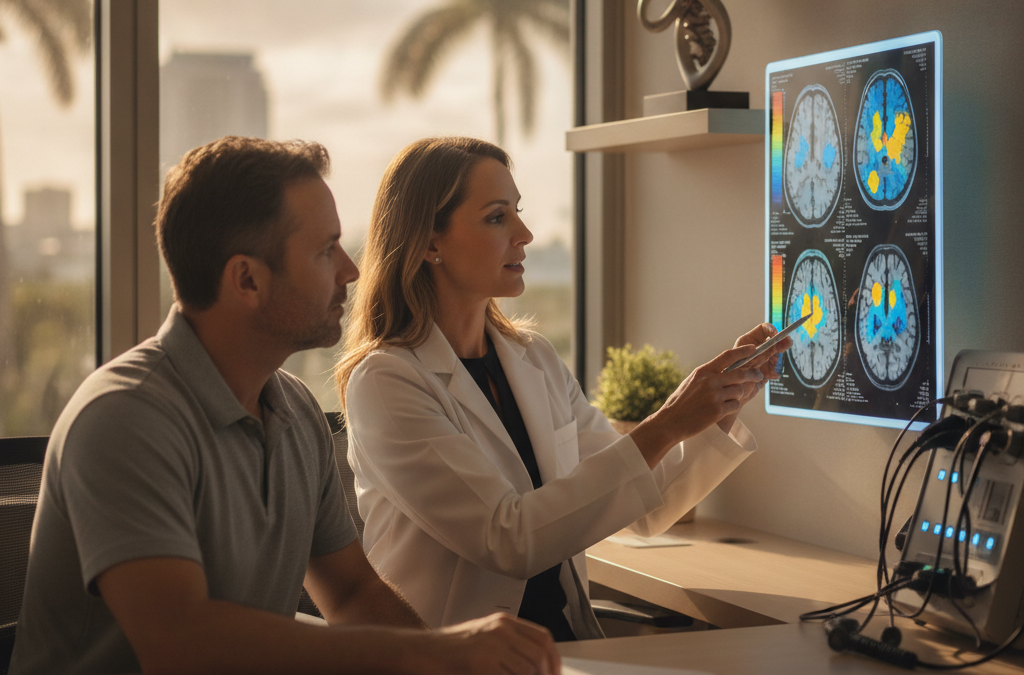
Evaluating neuroinflammation in clinical practice involves a combination of detailed symptom history, cognitive and neurological functional testing, and in some cases advanced biomarker panels and neuroimaging protocols that go beyond the standard ER workup. The goal is not just to confirm that something is wrong — you already know something is wrong — but to understand the specific pattern of dysfunction so that treatment can be genuinely targeted.
Treatment approaches that address neuroinflammation as a root driver of symptoms may include:
- Regenerative medicine and stem cell therapy: One of the most promising and underutilized approaches in TBI recovery involves using regenerative medicine tools to support the brain’s own healing environment. Stem cell therapy, in particular, has shown significant potential for modulating microglial activity — essentially helping to calm the overactivated immune cells that are sustaining the inflammatory state. Regenerative approaches work by supporting tissue repair and creating a biological environment more conducive to recovery, rather than simply suppressing symptoms. Our stem cell therapy program is designed for patients with brain and spine injuries who have not found adequate relief through conventional care.
- Targeted anti-inflammatory protocols: Addressing systemic contributors that amplify neuroinflammation — including metabolic, nutritional, and lifestyle factors — is often a critical part of recovery that patients have never been guided through.
- Neurological rehabilitation to restore function: Rehabilitation that accounts for neuroinflammatory patterns helps retrain neural pathways and supports gradual return to cognitive and physical function without triggering symptom flares.
Who Is Most at Risk for Chronic Neuroinflammation in the Tampa Area?
Chronic neuroinflammation after brain injury is not limited to catastrophic TBIs. Some of the patients most affected are those whose injuries were initially minimized — the concussion that was called mild, the fender bender on I-275 that seemed like no big deal, the head impact during a youth soccer game in Hillsborough County that the parent was told would resolve on its own.
The Tampa Bay area’s combination of high traffic volumes on I-275 and I-4 and one of the most active youth and adult sports communities in the Gulf Coast region means that concussions and mild TBIs are happening at high frequency. Many of those patients never receive the follow-up evaluation needed to catch chronic neuroinflammation before it becomes deeply entrenched. Older adults in Land O’ Lakes and surrounding Pasco County retirement communities are also at elevated risk — the aging brain is less efficient at resolving inflammatory states after injury, and many of these patients are managing other health conditions that make them hesitant to pursue surgery or long-term medication.
If you or someone you care about falls into any of these groups, a consultation is the right next step — not to commit to any particular treatment, but to understand what is actually driving your symptoms and what options exist. You can schedule a consultation with our team here.
Frequently Asked Questions About Neuroinflammation and Brain Injury Care in Tampa
Can neuroinflammation develop after a mild concussion, or only after severe TBI?
Chronic neuroinflammation can develop after injuries of any severity, including concussions that were initially classified as mild. The severity of the initial impact does not reliably predict whether the inflammatory response will self-resolve or persist. Many patients with mild-to-moderate TBIs experience prolonged neuroinflammation that drives symptoms for months or years.
Why don’t standard MRI or CT scans show neuroinflammation?
Standard imaging is designed to detect structural damage — bleeding, fractures, large lesions. Chronic cellular-level neuroinflammation does not produce the kind of visible structural changes that show up on routine scans. Advanced imaging modalities and clinical biomarker evaluation are better tools for identifying this process, and a thorough functional evaluation of your symptoms can be equally informative.
How long does neuroinflammation last after a brain injury?
Without targeted intervention, neuroinflammation can persist for months or even years after the original injury. Research has documented microglial activation in TBI patients years after the event. This is exactly why patients who are told their injury was a long time ago and should have healed by now continue to suffer — time alone does not always resolve the underlying inflammatory process.
Is stem cell therapy approved for treating neuroinflammation after TBI?
Regenerative medicine for TBI is an evolving field with growing clinical evidence. At Advanced Brain and Spine, stem cell therapy is offered as part of a personalized treatment program after a thorough evaluation to determine candidacy. Our team will always give you an honest assessment of whether you are likely to benefit and what the process looks like — we do not offer one-size-fits-all treatment.
Where do patients from Land O’ Lakes and Pasco County go for this type of specialized care?
Patients across Pasco County and the Land O’ Lakes area often have limited access to specialized brain injury care outside of large hospital-system neurology departments, which are typically focused on acute care and general neurology rather than chronic post-injury recovery. Advanced Brain and Spine serves patients from throughout the region, including Land O’ Lakes, Hillsborough County, and Pasco County, and offers a focused, specialist-level approach to TBI and brain injury recovery.
You Deserve a Real Answer — Not Just “Your Scans Look Fine”
If you have been suffering for months, told that your imaging is normal and there is nothing more to be done, and you know in your body and your mind that something is still wrong — you are right to keep looking for answers. Neuroinflammation is real, it is measurable in how it affects your function and your quality of life, and it is addressable with the right evaluation and the right treatment team.
The team at Advanced Brain and Spine is here to provide the thorough, specialist-level evaluation and evidence-informed care that patients across Tampa, Land O’ Lakes, and the surrounding Hillsborough and Pasco County communities deserve. Contact us today to request a consultation and find out whether neuroinflammation may be the missing piece in your recovery — and what we can do about it together. Reach out to our team here.