
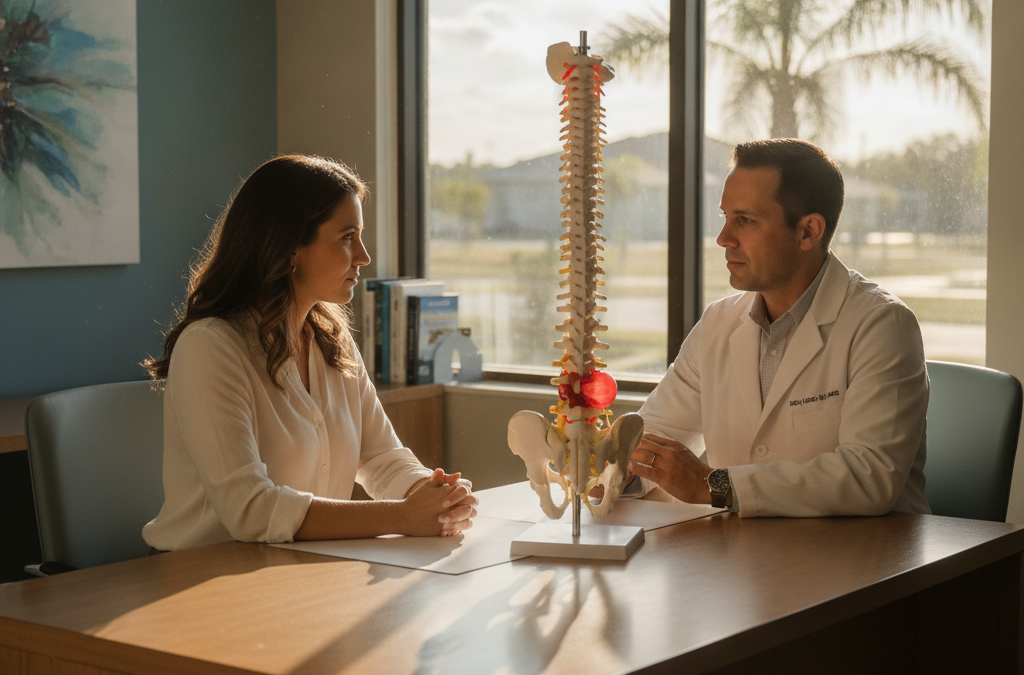
What Is the Difference Between a Herniated Disc and a Pinched Nerve in Wesley Chapel?
If you’ve been told you might have a herniated disc — or you’ve been describing shooting pain down your arm or leg and someone mentioned a “pinched nerve” — you may be wondering whether these are the same thing. They’re closely related, but they’re not identical, and the distinction matters when it comes to your treatment. At Advanced Brain & Spine in Tampa, we see patients from Wesley Chapel, Land O’ Lakes, Lutz, and across the greater Pasco and Hillsborough County corridor who are dealing with exactly this kind of pain, often after a car accident or a fall, and often without a clear explanation from whoever saw them first.
This article breaks down what each condition actually is, how they overlap, what your symptoms are telling you, and what your realistic options look like — before you end up in a surgery consultation you may not need.
What Is a Herniated Disc — and What Makes It Different From a Pinched Nerve?
Your spine is made up of bones (vertebrae) stacked on top of each other, with cushioning discs between them. Each disc has a tough outer layer and a softer, gel-like center. A herniated disc happens when that outer layer tears or weakens and the inner material pushes outward. Sometimes this is called a slipped disc or a ruptured disc, though the mechanics are slightly different in each case.
A pinched nerve — medically called radiculopathy — is what happens when that displaced disc material (or bone spur, or inflamed tissue) presses against a nearby nerve root as it exits the spine. So in many cases, a herniated disc causes a pinched nerve. But not every herniated disc compresses a nerve, and not every pinched nerve is caused by a herniated disc.
Here’s why this matters: if your disc is herniated but not pressing on a nerve, you’ll likely feel localized back or neck pain. If it’s compressing a nerve root, you’ll feel pain, numbness, tingling, or weakness that radiates along the path of that nerve — down your arm, into your hand, down your leg, or into your foot. That radiating pattern is a key clue that nerve involvement is part of the picture.
How Do You Know Which One You Have? Symptoms Side by Side
Both conditions can present with overlapping symptoms, which is part of why patients often feel frustrated after a basic exam. Here are the patterns worth knowing:
- Herniated disc without nerve compression: Aching or stiffness localized to the lower back or neck, worsens with certain movements, improves with rest
- Pinched nerve (radiculopathy): Sharp, burning, or electric pain that travels — often down one arm or leg — along with numbness, tingling, or muscle weakness in the affected limb
- Cervical radiculopathy (neck-level): Radiating pain into the shoulder, arm, or hand; grip weakness; numbness in fingers
- Lumbar radiculopathy (lower back-level): Sciatic pain down the buttock, thigh, and calf; foot drop in severe cases; numbness along the outer leg or into the foot
If your symptoms are primarily radiating — meaning they travel beyond your spine — nerve involvement is likely and warrants a more thorough neurological and imaging workup than a standard orthopedic exam provides.
Why This Distinction Gets Missed — Especially After Accidents
This is one area where many patients in the Wesley Chapel and New Tampa area fall through the cracks. After a motor vehicle accident or a slip-and-fall, the immediate focus is often on ruling out fractures or acute injury. A disc herniation that develops or worsens in the days following an accident may not show up on early imaging or be fully appreciated in an urgent care or ER setting.
Disc injuries from MVAs can be subtle at first. The adrenaline response after a crash suppresses pain acutely, and patients often feel the full extent of their injury 24 to 72 hours later. By that point, they may have already been discharged with a prescription for muscle relaxers and a follow-up with a general practitioner — without anyone looking specifically at nerve root compression or disc integrity.
If you were in an accident along I-275, the Veterans Expressway, or anywhere else in Hillsborough or Pasco County and you’re now experiencing radiating pain, weakness, or numbness, that’s a signal your care needs to go deeper than what most emergency visits provide. Florida’s no-fault PIP insurance covers initial medical evaluation, but documenting nerve involvement early — with appropriate imaging and a specialist evaluation — is critical both for your health and for any insurance claim or legal matter that follows.
Diagnosis: What a Specialist Evaluation Actually Involves
A thorough evaluation for a suspected herniated disc or pinched nerve goes beyond pressing on your back and asking where it hurts. At Advanced Brain & Spine, Dr. Saldin — Duke-trained in neurology and board-certified in pain medicine through the University of Virginia — approaches this with both neurological precision and spine-focused clinical judgment.
A complete evaluation typically includes:
- A detailed neurological exam to map which nerve roots may be affected based on reflex, strength, and sensory testing
- Review of any existing imaging (X-ray, MRI, CT), with interpretation in context of your specific symptoms
- Discussion of mechanism of injury — how and when the pain started, what makes it better or worse
- Assessment of whether your symptoms warrant additional diagnostic imaging if not yet completed
MRI is the gold standard for visualizing disc herniation and nerve root compression. But imaging findings must always be interpreted alongside your symptoms — a disc that looks abnormal on MRI isn’t necessarily causing your pain, and vice versa. This is where neuroimaging specialization makes a real difference in avoiding both over-treatment and under-treatment.
Treatment Options: From Conservative Care to Targeted Interventions
Most herniated discs and pinched nerves do not require surgery. The majority of patients respond well to a structured, step-wise approach. Here’s how that typically unfolds:
First-line management usually involves physical therapy, anti-inflammatory medication, and activity modification. For many patients, this is enough — especially if nerve compression is mild and the disc herniation is small.
When pain persists beyond four to six weeks, or when nerve symptoms are significant enough to affect daily function, targeted injections become an appropriate next step. Epidural steroid injections and facet joint injections are two of the most commonly used procedures for this:
- Epidural steroid injections deliver anti-inflammatory medication directly into the epidural space near the affected nerve root, reducing swelling and relieving radiating pain. These are particularly useful for lumbar and cervical radiculopathy.
- Facet joint injections target the small joints between vertebrae, which can become inflamed and painful independently of disc issues. They’re more appropriate when the pain pattern suggests facet involvement rather than nerve root compression.
For patients interested in regenerative approaches — particularly those with disc degeneration or soft tissue injury who want to address the underlying structural problem rather than just manage symptoms — stem cell therapy is another avenue worth a serious conversation. It won’t be appropriate for every patient, but for the right candidate, it can support tissue repair in a way that traditional pain management does not.
Frequently Asked Questions
Can a herniated disc heal on its own?
In many cases, yes — particularly if the herniation is small and nerve compression is not severe. The disc’s outer material can reabsorb over time, and symptoms often improve within six to twelve weeks with conservative care. That said, if you’re experiencing significant nerve symptoms or worsening weakness, waiting without specialist input is not advisable.
How do I know if I need an MRI versus just an X-ray?
X-rays show bone and can rule out fracture or significant alignment problems, but they don’t show disc material or nerves. If your pain is radiating, if you have numbness or weakness, or if conservative treatment isn’t working after a few weeks, an MRI is typically the appropriate next step.
I was in a car accident in Wesley Chapel two weeks ago and now have leg pain. Is this related?
It very likely could be. Post-MVA disc injuries don’t always appear immediately, and radiating leg pain is a classic sign of lumbar nerve root involvement. Getting a timely specialist evaluation is important both for your recovery and for properly documenting the injury in connection with your accident claim under Florida’s PIP and potential liability coverage.
Are epidural steroid injections the same as surgery?
No. Epidural injections are minimally invasive procedures performed with imaging guidance — typically fluoroscopy — in an outpatient setting. They don’t require general anesthesia or incisions. Most patients go home the same day and return to normal activity quickly, though full relief may take a few days to develop.
Do I need a referral to see a spine specialist in Tampa?
Not necessarily. Many patients come to Advanced Brain & Spine directly, especially after an accident. If you’re using attorney-referred or letter-of-protection (LOP) care arrangements common in Florida personal injury cases, a referral is generally not required. It’s worth calling ahead to discuss your specific insurance or payment situation.
Get a Clear Diagnosis Before You Commit to a Treatment Plan
If you’re living with back or neck pain that’s been brushed off, undertreated, or explained without much detail — especially after an accident or fall — you deserve a more thorough look. Herniated discs and pinched nerves are highly treatable when they’re properly identified and matched to the right intervention. The mistake most patients make is either waiting too long or accepting a generic treatment plan that doesn’t account for what’s actually compressing that nerve.
Advanced Brain & Spine serves patients throughout the Tampa Bay area, including Wesley Chapel, Lutz, Land O’ Lakes, New Tampa, and surrounding Hillsborough and Pasco County communities. Whether you’re coming in from close by or driving in from further afield, the goal is the same: a precise diagnosis and a treatment plan that’s built around your specific injury — not a one-size-fits-all protocol.
Request a consultation today and take the first step toward understanding what’s actually driving your pain — and what can genuinely be done about it.