
What Is Hyperbaric Oxygen Therapy for TBI — and Why Are So Many Patients in Wesley Chapel and Lutz Not Being Offered This Treatment After a Brain Injury?
Hyperbaric oxygen therapy — often called HBOT — is a medically supervised treatment in which you breathe pure oxygen inside a pressurized chamber, delivering significantly higher concentrations of oxygen to your tissues than what normal air provides. For patients recovering from a traumatic brain injury in Tampa, Wesley Chapel, Lutz, and surrounding communities, HBOT is one of the most clinically promising tools available. And yet, the vast majority of brain injury patients in this area have never been told it exists. If you’re still dealing with persistent headaches, brain fog, memory problems, fatigue, or emotional instability months after an accident or head injury — and nobody has mentioned hyperbaric oxygen therapy — this article is worth reading carefully.
Why the Injured Brain Needs More Than Rest
After a traumatic brain injury, the damage to brain tissue isn’t always from the impact alone. Much of it comes from what happens in the hours, days, and weeks that follow — a cascade of inflammation, reduced blood flow, and oxygen deprivation that can continue long after the initial injury. The brain is extraordinarily sensitive to oxygen levels. When circulation is disrupted or inflammation restricts blood flow to certain regions, brain cells that weren’t destroyed by the original injury begin to suffer anyway. These cells aren’t dead — they’re in a kind of metabolic hibernation, sometimes called the ischemic penumbra. The right intervention can wake them back up.
That’s the core premise behind HBOT for TBI. By placing you in a pressurized environment and having you breathe 100% oxygen, the treatment allows oxygen to dissolve directly into your blood plasma — bypassing the red blood cells that normally carry it. This allows oxygen to reach areas of the brain where circulation has been compromised. Over multiple sessions, this can reduce neuroinflammation, stimulate the growth of new blood vessels, and support the activation of dormant brain tissue.
What a Hyperbaric Oxygen Session Actually Involves
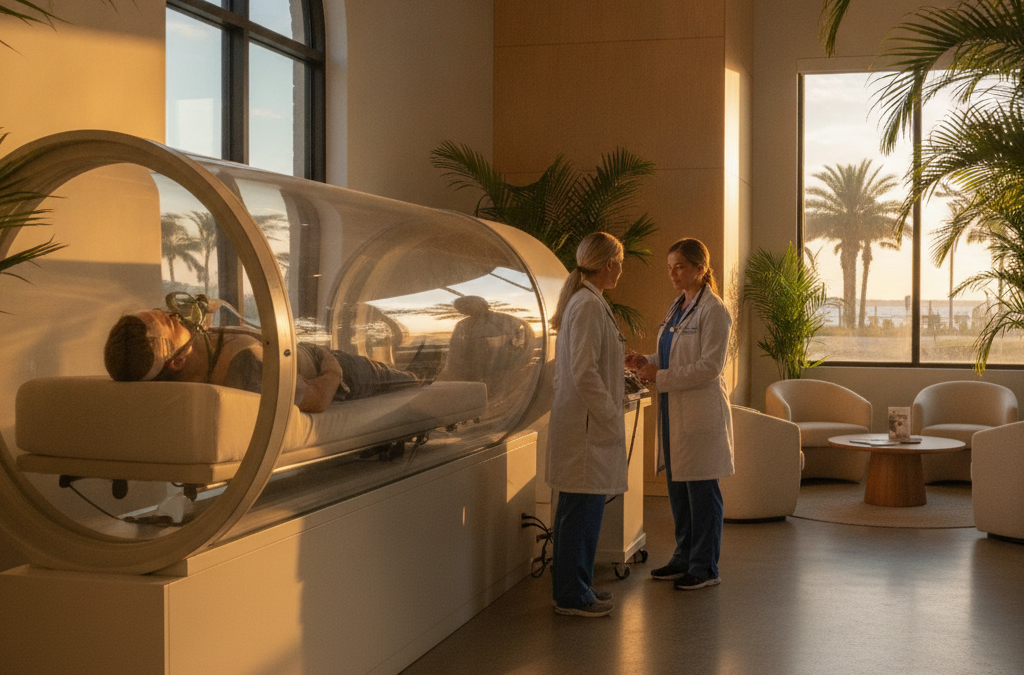
If you’ve never encountered HBOT before, the idea of sitting in a pressurized chamber can sound intimidating. In practice, most patients describe the experience as surprisingly comfortable. You lie or sit inside a clear or enclosed chamber — depending on the system being used — while the pressure inside is gradually increased to between 1.5 and 2.0 atmospheres of pressure (or higher, depending on the treatment protocol). You breathe pure oxygen through a mask or hood for the duration of the session, which typically lasts 60 to 90 minutes.
During the session, you may notice a slight pressure sensation in your ears — similar to what you feel when an airplane descends — which equalizes quickly. Most patients read, rest, or simply relax during treatment. Afterward, many report feeling calm or mildly fatigued, though some notice increased alertness over the course of a full treatment course.
For TBI recovery, HBOT is rarely a one-session fix. A complete treatment protocol typically involves multiple sessions over several weeks. The exact number depends on the severity of your injury, how long ago it occurred, your current symptoms, and how your brain responds early in the course of treatment. A thorough neurological evaluation before starting is essential to establish a baseline and tailor the protocol appropriately.
The Gap Most Local Clinics Are Missing
Here’s what stands out when you look at the landscape of brain and spine care providers in the Tampa Bay area: most competitors list TBI as a condition they treat, but very few go into meaningful detail about HBOT as part of a TBI recovery plan. The content gap is significant. Patients in Lutz, Wesley Chapel, Land O’ Lakes, and New Tampa who search for brain injury treatment are being routed toward generic neurological follow-up and symptom management — not toward treatments that actively support neurological healing.
This matters because many of the patients who need HBOT most are the ones who’ve already tried the standard path. They’ve had a follow-up MRI that came back normal. They’ve been told their concussion should have healed by now. They’re on their second or third medication for headaches that won’t respond. They’re struggling at work or with their family and don’t understand why. The honest answer is that a normal MRI doesn’t rule out neurological dysfunction — it just means conventional imaging didn’t detect it. Functional problems can persist even when structural scans look clean, and HBOT is one of the few treatments designed to address that gap directly.
At Advanced Brain & Spine, the approach to TBI is built around exactly this kind of precision thinking. Dr. Saldin’s background — Duke-trained in neurology, board-certified in pain medicine through the University of Virginia, and specialized in neuroimaging — means that evaluations don’t stop at a normal scan. Functional symptoms get taken seriously, and treatment plans are built around what your brain actually needs, not what a standard protocol assumes. You can learn more about our approach to hyperbaric oxygen therapy for TBI and what that process looks like for patients like you.
Who Is a Good Candidate for HBOT After a Brain Injury?
Not every TBI patient will be an ideal candidate for hyperbaric oxygen therapy, which is why a proper evaluation always comes first. That said, HBOT tends to be most relevant for patients who fall into one or more of these categories:
- Mild to moderate TBI with persistent post-concussion symptoms lasting beyond 3 months
- Patients whose imaging appears normal but who continue to experience cognitive, sensory, or emotional symptoms
- Brain injury from a motor vehicle accident, slip-and-fall, or other trauma that occurred within the past several years
- Patients who have plateaued with other treatments and are not seeing further improvement
- Those dealing with chronic post-traumatic headaches, difficulty concentrating, disrupted sleep, or mood changes linked to a documented or suspected brain injury
HBOT is not appropriate for everyone — certain respiratory conditions, ear or sinus issues, and other health factors may affect candidacy. A thorough medical review is always part of the process before treatment begins.
HBOT, MVA Injuries, and Navigating Care in Tampa Bay
If your TBI resulted from a motor vehicle accident — a common scenario given the high volume of crashes along the I-275 corridor and across Hillsborough and Pasco counties — you may have concerns about how treatment will be covered. Florida’s no-fault insurance system (PIP) covers a portion of accident-related medical care, but it has limits, and HBOT is often not included in standard auto insurance coverage without proper documentation and medical justification.
For patients working with a personal injury attorney, lien-based (letter of protection) arrangements may allow you to receive treatment now and have costs addressed when your case resolves. Advanced Brain & Spine works with patients navigating these situations and can help clarify your options during your consultation. The key is not to delay evaluation. The earlier a brain injury is properly documented and treated, the stronger both your health outcome and your legal record will be.
If you’re in Wesley Chapel or Lutz and wondering where to start, a detailed neurological evaluation is the right first step — not a general practitioner referral and a wait-and-see approach. You can review the full range of TBI treatment options available at Advanced Brain & Spine before your appointment.
Frequently Asked Questions
Is hyperbaric oxygen therapy FDA-approved for TBI?
HBOT is FDA-approved for certain conditions, though TBI is currently classified as an off-label use. That doesn’t mean it lacks evidence — a growing body of peer-reviewed research supports its use in TBI recovery, and many neurologists and brain injury specialists incorporate it as part of a comprehensive treatment protocol. Your physician will discuss what the evidence shows and how it applies to your specific situation.
How many HBOT sessions will I need for a brain injury?
Most TBI treatment protocols involve somewhere between 20 and 40 sessions, though this varies based on injury severity, symptom duration, and individual response to treatment. Your treating physician will evaluate your progress throughout the course and adjust accordingly. It’s not a commitment you make blindly — it’s a monitored process with reassessment built in.
Can HBOT help if my TBI happened years ago, not recently?
Yes — this surprises many patients, but HBOT has shown benefit even for chronic TBI, not just acute cases. Dormant or under-functioning brain tissue can still respond to oxygen-rich environments even years after an injury, particularly when neuroinflammation is part of the ongoing picture. An evaluation will help determine whether your brain injury pattern is one that’s likely to respond.
I’m in Wesley Chapel. Is Advanced Brain & Spine accessible from there?
Yes. Advanced Brain & Spine is located in Tampa at 10213 Wilsky Boulevard, and patients regularly travel from Wesley Chapel, Lutz, Land O’ Lakes, New Tampa, and throughout Pasco County for evaluation and treatment. The drive is straightforward for most patients in these communities.
What if I’ve already been told my brain injury has healed?
A normal MRI or a doctor telling you to “give it more time” doesn’t mean your brain has fully recovered — it often means the evaluation wasn’t thorough enough to capture what’s still happening neurologically. If you have persistent symptoms, you deserve a specialist-level assessment, not reassurance that doesn’t match how you actually feel. That’s exactly the kind of evaluation we provide.
Take the Next Step Toward Real Recovery
If you’re in Wesley Chapel, Lutz, or anywhere in the Tampa Bay area and you’re still living with the effects of a traumatic brain injury — whether it happened recently or years ago — you don’t have to keep waiting for symptoms to resolve on their own. Hyperbaric oxygen therapy may be one piece of a treatment plan that finally helps your brain heal the way it needs to. The first step is an honest, thorough evaluation with a neurologist who takes your symptoms seriously and has the training to interpret what’s actually going on.
Advanced Brain & Spine specializes in exactly this kind of care. Request a consultation today and find out whether HBOT or another targeted approach is right for your recovery.