
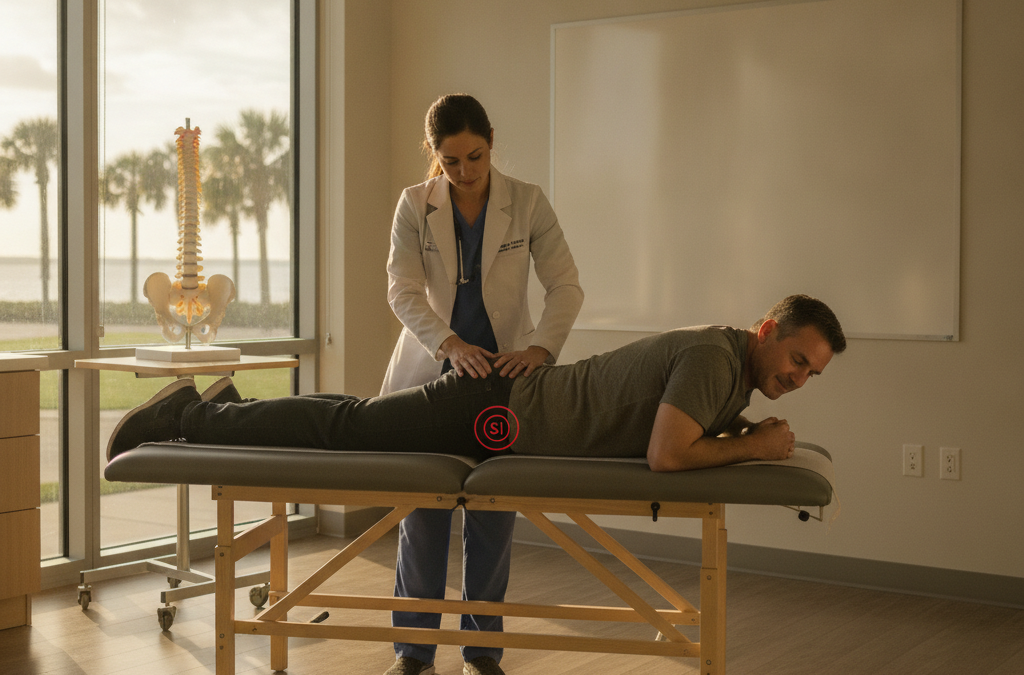
What Is Sacroiliac Joint Dysfunction — and Why Are So Many Patients in Lutz and Wesley Chapel Being Treated for the Wrong Type of Lower Back Pain?
If you’ve been living with lower back pain that radiates into your hip, buttock, or upper leg — and physical therapy, disc injections, or chiropractic care haven’t given you lasting relief — there’s a real possibility you’ve been treating the wrong structure entirely. Sacroiliac (SI) joint dysfunction is responsible for an estimated 15 to 30 percent of all chronic lower back pain cases, yet it’s one of the most frequently misdiagnosed conditions at general orthopedic and primary care offices throughout Tampa, Lutz, Wesley Chapel, and the surrounding communities in Hillsborough and Pasco Counties. This article explains what the sacroiliac joint actually does, why its dysfunction so often gets mistaken for disc or nerve problems, and what a proper evaluation and treatment plan should look like.
What Exactly Is the Sacroiliac Joint — and What Goes Wrong With It?
Your sacroiliac joints are the two joints that connect your sacrum — the triangular bone at the base of your spine — to your iliac bones on either side of your pelvis. They’re strong, weight-bearing joints reinforced by thick ligaments, and they absorb and distribute force between your upper body and legs every time you walk, stand, or sit. Most people don’t think about them until something goes wrong.
When the SI joint becomes inflamed, hypermobile, or locked in an abnormal position, it produces pain that almost perfectly mimics a lumbar disc herniation or radiculopathy. You might feel a deep ache in your lower back, a sharp catch on one side when you stand up from a chair, pain that travels into the groin or down the back of your thigh, or discomfort that’s worse when you climb stairs or roll over in bed at night. Sound familiar?
The tricky part is that a standard MRI of the lumbar spine often doesn’t capture the sacroiliac joints clearly, and a herniated disc or degenerative change at L4-L5 or L5-S1 may show up on imaging even when it’s not the primary pain generator. Clinicians who aren’t specifically trained to differentiate these sources will often treat what the imaging shows — not what’s actually hurting you.
Why This Diagnosis Gets Missed So Often in Tampa Bay
Part of the problem is volume. Clinics that handle large numbers of motor vehicle accident (MVA) and slip-and-fall patients — and there are many along the I-275 and Veterans Expressway corridors in Tampa — often rely on fast, protocol-driven imaging reviews rather than hands-on, targeted physical examination. In a high-volume setting, if the MRI shows a disc bulge, that bulge becomes the default explanation for your pain, whether or not it’s actually causing your symptoms.
Another factor is that many general practitioners and even some spine specialists aren’t trained in the specific provocative maneuvers — tests like the FABER, Gaenslen’s, and distraction tests — that are designed to stress the sacroiliac joint and reproduce a patient’s pain. Without those exam techniques, the joint goes unexamined, the diagnosis goes unmade, and the patient continues suffering through treatments aimed at the wrong target.
Patients in Lutz and Wesley Chapel who were injured in a rear-end collision, a fall on an uneven surface, or even a sports-related impact are especially prone to SI joint injury because the force of those events can stress or partially disrupt the ligaments that stabilize the joint. If your initial evaluation didn’t include a targeted SI joint examination, it’s worth asking whether that structure has been properly ruled out.
How Sacroiliac Joint Dysfunction Is Properly Diagnosed
A thorough evaluation for SI joint dysfunction involves more than reviewing imaging. It starts with a detailed history of your pain — what aggravates it, what relieves it, exactly where it radiates, and how it changed after your injury. From there, a clinician trained in pain medicine and spine anatomy will perform a series of physical examination tests specifically designed to provoke or relieve pressure on the joint.
When clinical signs are present, a diagnostic SI joint injection is often the most definitive tool available. This involves injecting a small amount of local anesthetic into the joint under fluoroscopic (X-ray) guidance. If your pain temporarily resolves following the injection, it confirms the sacroiliac joint as the pain source — and gives you a clear path forward for treatment.
This level of specificity matters enormously, both for your recovery and for any legal or insurance documentation you may need to support a personal injury claim. Vague imaging findings and incomplete exams don’t hold up well when you’re trying to get the care — and compensation — you deserve after an accident. You can learn more about the full range of spine care services available at Advanced Brain & Spine to understand how these evaluations fit into a comprehensive plan.
Treatment Options: From Targeted Injections to Regenerative Therapies
Once the SI joint is confirmed as the pain source, treatment becomes much more precise — and much more effective. Options range from conservative to interventional depending on the severity of your dysfunction and how your body responds.
- SI joint injections: Corticosteroid injections into the joint can reduce inflammation and provide meaningful pain relief, sometimes for months at a time. These are often the first interventional step and are performed with imaging guidance for accuracy.
- Radiofrequency ablation (RFA): If injections provide relief but it wears off, RFA uses heat to disrupt the nerve fibers transmitting pain from the joint. This can extend relief significantly — sometimes for a year or more.
- Regenerative options: For patients with ligamentous laxity or chronic joint instability — a common finding after traumatic injury — regenerative approaches including stem cell therapy for injury repair may help stabilize damaged tissue and reduce ongoing inflammation in ways that injections alone cannot.
- Targeted physical rehabilitation: Once pain is sufficiently controlled, specific stabilization exercises can help restore proper joint mechanics and reduce the likelihood of recurrence.
The right combination depends on your individual presentation. There’s no single protocol that works for every patient, which is exactly why thorough upfront evaluation matters so much.
What Patients in Lutz, Land O’ Lakes, and Wesley Chapel Should Know About Getting Evaluated
If you were injured in a car accident or a slip-and-fall anywhere in the Wesley Chapel, Lutz, or Land O’ Lakes areas and you’re still in pain weeks or months later, you don’t have to accept “your MRI looks okay” as a complete answer. SI joint dysfunction, like many soft tissue and joint injuries, often doesn’t show clearly on standard lumbar MRI — which means a normal scan does not rule it out.
At Advanced Brain & Spine in Tampa, Dr. Saldin brings Duke-trained neurology expertise and board certification in pain medicine from the University of Virginia to every evaluation. That combination means your spine is being assessed by someone who understands both the neurological and structural dimensions of your pain — not just one piece of the puzzle. For patients navigating the Florida no-fault (PIP) insurance system or working with an attorney on a personal injury claim, this level of documentation and diagnostic precision can make a meaningful difference in the outcome of your case.
Frequently Asked Questions
How do I know if my lower back pain is from the SI joint or a disc?
The symptoms can overlap significantly, which is why clinical examination — not just imaging — is essential. SI joint pain typically centers around the dimple area at the base of your spine, often on one side, and may radiate into the buttock or groin without traveling below the knee. Disc-related nerve pain more commonly follows a defined path down the leg. A diagnostic injection is the most reliable way to confirm which structure is responsible.
Can a car accident in Tampa cause sacroiliac joint injury?
Yes. The force from a rear-end collision, side impact, or even a hard stop can strain the ligaments of the SI joint, causing it to become hypermobile or inflamed. This is particularly common in accidents where your body was twisted or your pelvis absorbed asymmetric force. Patients throughout Tampa, Lutz, and Wesley Chapel who’ve been in MVAs should ask specifically whether their SI joint was examined if their lower back pain persists.
Does Florida PIP insurance cover SI joint injections?
Florida’s personal injury protection (PIP) coverage typically applies to treatment that is medically necessary and initiated within 14 days of an accident. If your SI joint dysfunction is documented as accident-related, the associated diagnostic work and injections may be covered. Attorney-referred patients often receive care on a lien basis, meaning payment is deferred until their claim is settled. Advanced Brain & Spine works with patients in these situations regularly.
How many SI joint injections will I need?
That depends on how your body responds. Some patients get significant relief from a single injection that lasts several months. Others need a series of treatments or may benefit from stepping up to radiofrequency ablation or regenerative therapy. Your provider should discuss realistic expectations before you begin — not make promises based on a single treatment.
Is this condition treated differently if I’ve already had lumbar spine surgery?
Yes, and this is an important distinction. Patients who’ve had lumbar fusion surgery are actually at higher risk for developing SI joint dysfunction afterward, because the fusion alters how forces are distributed through the pelvis. If you had surgery and your pain returned or changed character, the SI joint is one of the first structures that should be re-evaluated.
Ready to Get a Diagnosis That Actually Fits Your Pain?
If you’ve been managing lower back pain in Lutz, Wesley Chapel, or anywhere in the Tampa Bay area without getting the answers you need, it may be time for an evaluation by a specialist who looks beyond the standard imaging checklist. At Advanced Brain & Spine, we take the time to understand the full picture of your injury — because treating the right problem with the right approach is the only way to get you real, lasting relief.
Book a consultation today and take the first step toward a diagnosis that actually explains your pain — not just one that matches your MRI.