
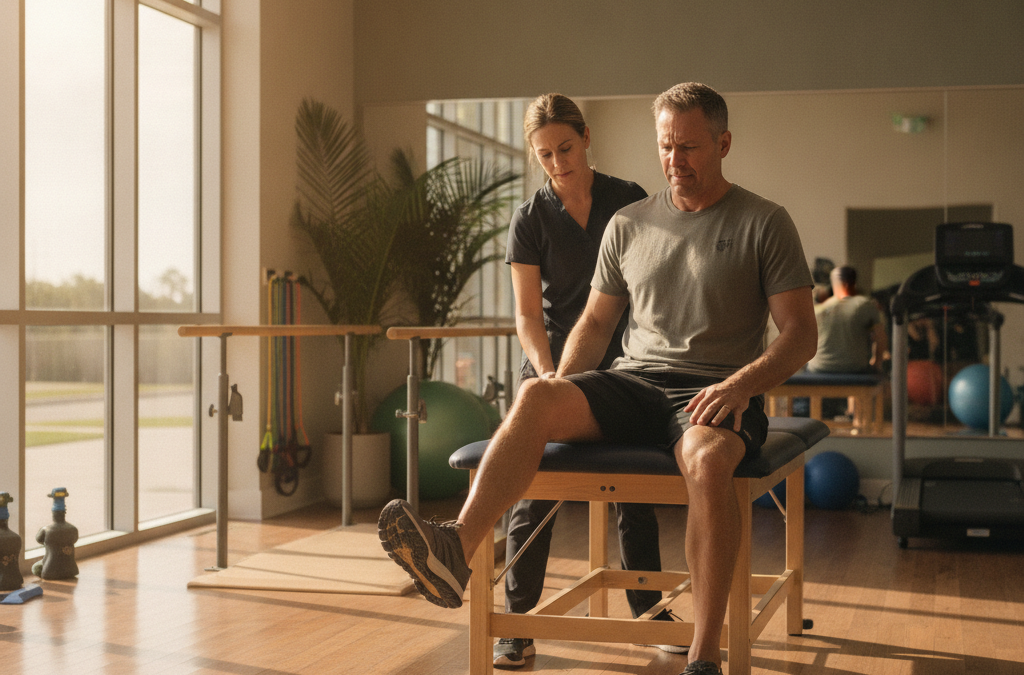
What Is Spasticity After a Brain or Spinal Injury — and Why Are So Many Patients in Land O’ Lakes and Lutz Not Getting the Right Care?
If your muscles feel constantly stiff, tightly clenched, or like they’re resisting your own movement after a car accident, a fall, or a brain injury — you may be dealing with spasticity. It’s one of the most misunderstood and underdiagnosed consequences of traumatic brain injury (TBI) and spinal cord damage, and for patients in Land O’ Lakes, Lutz, and throughout northern Hillsborough and Pasco County, it’s far too often dismissed as general soreness or “tension” by providers who simply aren’t trained to recognize it for what it is.
Spasticity is not just tight muscles. It’s a neurological condition — one that, left unaddressed, can worsen over time, interfere with your ability to work or sleep, and significantly complicate your legal and insurance claim if you’ve been injured in an accident. Understanding what’s actually happening in your nervous system is the first step toward getting care that makes a real difference.
What Actually Causes Spasticity?
Your brain and spinal cord constantly send signals to your muscles, telling them when to contract and when to relax. After a traumatic brain injury or a significant spinal injury, that communication pathway gets disrupted. The inhibitory signals — the ones that tell muscles to release — become impaired. What’s left is a system stuck in a kind of overdrive, where certain muscle groups fire involuntarily, stay partially contracted, or resist normal range of motion even when you’re trying to relax.
Clinically, spasticity is characterized by velocity-dependent muscle tone — meaning the faster you try to move a limb, the more resistance you feel. It can affect one limb, a whole side of the body, or multiple regions depending on where the neurological injury occurred. Common signs include:
- Persistent stiffness in the arms, legs, or neck that doesn’t respond well to stretching
- Sudden, involuntary muscle spasms — especially at night
- Difficulty walking, gripping objects, or performing fine motor tasks
- Pain or cramping that seems to come from inside the muscle
- A feeling that your joints are “locked” or resisting movement
- Muscle fatigue from the constant effort of fighting your own muscle tone
These symptoms can develop gradually — sometimes weeks after the initial injury — which is one reason why patients in communities like Lutz and Land O’ Lakes often don’t connect them to their accident until significant time has passed.
Why This Diagnosis Gets Missed So Often — and What That Costs You
Here’s a gap that stands out clearly when you look at what local and regional spine and neurology competitors publish: almost none of them address spasticity as a distinct, diagnosable condition for accident victims. Most of the content out there focuses on pain, herniated discs, or concussion symptoms. Spasticity — a condition that neurologists and physiatrists deal with routinely — barely gets a mention.
The practical consequence of that gap is that patients across the Tampa Bay area, including those traveling down from Wesley Chapel or commuting through the Veterans Expressway corridor from Lutz, often spend months seeing primary care doctors or general practitioners who recognize the symptoms but don’t have the training to manage them properly. They may be prescribed muscle relaxants without any neurological evaluation, referred to physical therapy without a baseline assessment, or told their stiffness will resolve on its own.
Sometimes it does. But when spasticity is the result of genuine neurological disruption from a TBI or spinal cord injury, it typically requires a more structured approach — one that starts with a proper neurological evaluation to understand the location and severity of the underlying injury.
For patients with open accident claims, delayed or incomplete documentation of spasticity can also create real problems. If a neurologist hasn’t formally evaluated and recorded this condition as part of your injury profile, it may not be recognized in your insurance or legal case. Florida’s no-fault PIP system gives you a limited window to establish the medical basis for your injuries — and spasticity, if not documented correctly, can quietly fall through the cracks. Comprehensive medical care documentation from a qualified neurologist matters more than most patients realize.
What Proper Evaluation and Treatment Actually Looks Like
If spasticity is suspected, a thorough neurological evaluation is the essential starting point. At Advanced Brain & Spine in Tampa, that process is led by Dr. Saldin, a Duke-trained neurologist with specialized training in pain medicine from the University of Virginia — and board certification to match. The evaluation typically includes a detailed clinical history, a hands-on neurological examination to assess tone and reflex patterns, and, when indicated, diagnostic imaging to identify the source and extent of the neurological injury.
Treatment is individualized and generally layered. There’s no single solution for spasticity, and the right combination depends heavily on which muscle groups are affected, how severe the tone is, and what’s causing it. Common approaches include:
- Targeted medications: Oral agents like baclofen or tizanidine can help reduce overall muscle tone, but they require careful dosing because side effects — including fatigue and cognitive fog — can undermine recovery from TBI.
- Botulinum toxin injections: When spasticity is focal — confined to specific muscle groups — injections directly into the affected muscles can interrupt the overactive nerve-to-muscle signal for several months at a time, without systemic side effects.
- Structured physical rehabilitation: Stretching protocols, strengthening the opposing muscle groups, and gait retraining all play important roles, but they work best when paired with neurological management rather than substituted for it.
- Hyperbaric oxygen therapy: For patients whose spasticity is rooted in TBI, there is growing evidence that hyperbaric oxygen therapy — which delivers high-concentration oxygen under increased pressure — can support neurological recovery by promoting healing in oxygen-deprived brain tissue. Learn more about how hyperbaric oxygen therapy supports TBI recovery here.
- Regenerative approaches: In select cases involving soft tissue and nerve-related damage along the spine, regenerative therapies may be considered as part of a longer-term treatment plan.
Spasticity After a Spinal Injury: A Slightly Different Picture
When spasticity originates from spinal cord involvement rather than brain injury, the treatment calculus can shift. Cervical or thoracic spinal cord injuries — which can occur in moderate to severe rear-end collisions or hard falls — often produce spasticity in the legs, trunk, or lower extremities. This is distinct from the more localized spasticity that can follow a mild TBI, and it requires a neurology or spine specialist to assess carefully.
In these cases, the neurological evaluation needs to determine whether the spinal cord itself has sustained structural injury or whether the surrounding nerves and supportive tissue are the primary source of the problem. Spine care at Advanced Brain & Spine is designed to address both possibilities, with imaging-guided evaluation and treatment options that range from targeted injections to minimally invasive spine procedures, depending on the findings.
Patients coming in from Land O’ Lakes, Lutz, and the growing communities along the Highway 41 and I-275 corridor deserve a level of evaluation that actually accounts for the full picture — not a one-size-fits-all approach designed to move patients through quickly.
Frequently Asked Questions About Spasticity After Brain and Spinal Injuries
How is spasticity different from regular muscle soreness after an accident?
Regular post-accident muscle soreness tends to peak in the first few days and gradually improves. Spasticity, by contrast, is driven by abnormal nerve signaling — it often develops or worsens over weeks, doesn’t respond consistently to heat, rest, or over-the-counter pain relief, and tends to have a rhythmic or velocity-dependent quality when the affected limb is moved. A neurological examination can distinguish the two.
Can spasticity develop weeks or months after a car accident in Tampa?
Yes. It’s not uncommon for spasticity to emerge gradually as the nervous system responds to an injury that wasn’t immediately recognized as severe. Patients in Pasco County and Hillsborough County who weren’t hospitalized after their accident sometimes don’t notice the pattern until physical activity starts to reveal it. This is another reason prompt neurological evaluation after an accident matters — even if initial symptoms seem mild.
Will my PIP insurance or attorney lien cover treatment for spasticity?
In most cases, yes — if spasticity has been properly documented as part of your injury by a licensed neurologist. Florida’s PIP coverage applies to medically necessary treatment stemming from a covered accident, and attorney-referred lien-based care arrangements are commonly used for patients who need ongoing treatment while their case is pending. The key is getting evaluation and documentation in place as early as possible.
Is spasticity permanent after a TBI or spinal injury?
Not necessarily. Many patients see significant improvement with consistent, targeted treatment — especially when care begins before compensatory movement patterns become entrenched. The prognosis depends on the severity and location of the original neurological injury, but early intervention almost always leads to better functional outcomes than waiting.
Does Advanced Brain & Spine treat spasticity from both brain and spinal injuries?
Yes. Because Dr. Saldin’s training spans neurology, pain medicine, and neuroimaging, he is equipped to evaluate and treat spasticity regardless of whether it originates from a TBI, a spinal cord injury, or a combination of both — which is common in serious motor vehicle accidents. The goal is always to identify the source accurately before deciding on a treatment path.
You Deserve a Diagnosis That Actually Explains What’s Happening
If you’ve been dealing with unexplained muscle stiffness, spasms, or resistance in your limbs after an accident or head injury — and no one has given you a clear explanation for why — it’s time for a neurological evaluation from someone trained to look for it. Spasticity is a real, treatable condition. It doesn’t have to define your recovery.
Advanced Brain & Spine serves patients throughout the Tampa Bay area, including Land O’ Lakes, Lutz, Wesley Chapel, and the surrounding Pasco and Hillsborough County communities. Whether you’re dealing with the aftermath of a car accident, a slip and fall, or an injury that was never properly evaluated, our team is here to give you answers and a plan. Request a consultation today and take the first step toward understanding — and treating — what’s actually going on.