
What Is Hyperbaric Oxygen Therapy and Can It Really Help TBI Recovery in Tampa?
If you are recovering from a traumatic brain injury in the Tampa area and feel like your progress has stalled — the brain fog, the fatigue, the difficulty concentrating that just will not lift — you may have come across hyperbaric oxygen therapy (HBOT) as a possible next step. It is a legitimate treatment with real neurological science behind it, and for the right patient, it can make a meaningful difference. But it is also a therapy that gets oversimplified or misrepresented online, so let’s walk through what it actually is, how it works in the context of brain injury recovery, and what a thoughtful, personalized approach to HBOT looks like at a specialty clinic in Tampa.
What Hyperbaric Oxygen Therapy Actually Does
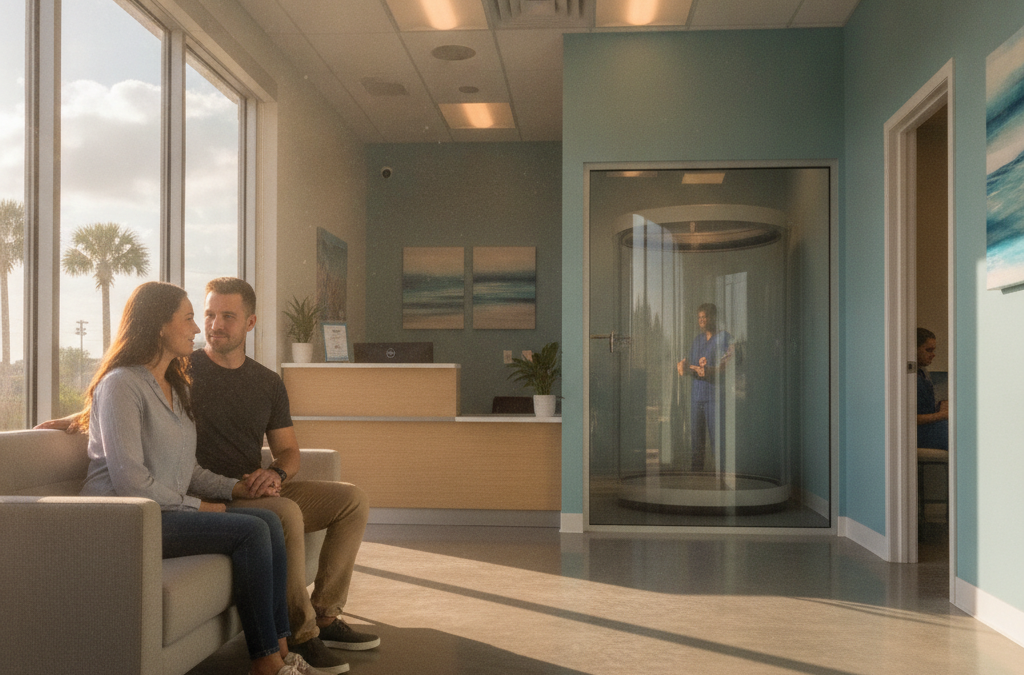
HBOT involves breathing pure oxygen inside a pressurized chamber — typically at 1.5 to 3 times normal atmospheric pressure. Under those conditions, your lungs absorb significantly more oxygen than they could at normal pressure, and that oxygen-enriched blood circulates throughout your body, including into tissues that are inflamed, oxygen-deprived, or healing slowly after injury.
In the context of a traumatic brain injury, this matters for a specific reason: after a TBI, certain regions of the brain enter a state of reduced blood flow and metabolic dysfunction — meaning the neurons are still there, they are not permanently dead, but they are not functioning properly. Researchers call this the “ischemic penumbra” — essentially a zone of injured brain tissue that may still be salvageable with the right intervention. The increased oxygen delivery that HBOT provides can help stimulate those dormant neurons, reduce neuroinflammation, and support the formation of new blood vessels in damaged areas, a process called angiogenesis.
None of this is science fiction. There is a growing body of peer-reviewed research — including work published in journals like PLOS ONE and Neurological Research — showing measurable improvements in cognitive function, memory, sleep, and mood in TBI patients treated with HBOT. The key word there is treated — meaning evaluated properly, dosed appropriately, and monitored by a clinician who understands both the therapy and the underlying neurological condition.
Who Is a Good Candidate for HBOT After a Brain Injury?
Not every TBI patient is an ideal candidate for hyperbaric oxygen therapy, and any clinic that tells you otherwise should give you pause. A proper evaluation comes first.
HBOT tends to show the strongest benefit for patients who are in what is sometimes called a “subacute” or “chronic” phase of TBI recovery — meaning the acute injury has stabilized, but symptoms like cognitive fog, persistent headaches, mood instability, memory issues, or fatigue are still present weeks, months, or even years later. This is actually more common than people realize. Many patients in Tampa and across Hillsborough County and Pasco County are walking around with the lingering effects of a brain injury from a car accident or a fall, having been told their imaging looks “normal” and there is nothing more to do.
That imaging-looks-normal situation is worth addressing directly. Standard MRI and CT scans are excellent at detecting structural damage — bleeding, large contusions, fractures — but they often miss the diffuse axonal injury and metabolic dysfunction that define many mild-to-moderate TBIs. This is a gap that a neurologist with neuroimaging specialization can help navigate, using more sensitive imaging approaches alongside a thorough clinical evaluation to get a clearer picture of what is actually happening in your brain.
Good candidates for HBOT typically include patients who:
- Have persistent post-concussion or post-TBI symptoms lasting more than a few weeks
- Have already tried conventional rehabilitation with incomplete improvement
- Do not have contraindications such as untreated pneumothorax, certain lung conditions, or active ear infections
- Are committed to completing a full course of treatment — typically 40 or more sessions for TBI protocols
What a Course of HBOT Treatment Actually Looks Like
A single HBOT session typically lasts between 60 and 90 minutes. You recline inside the chamber, breathe normally, and the pressure and oxygen levels are gradually adjusted according to the treatment protocol. Most patients describe it as uneventful — some read, some rest, some fall asleep. Your ears may feel a mild pressure change, similar to what you experience during a flight descent, which you equalize the same way.
For TBI recovery, a meaningful course of treatment is generally not a handful of sessions — it is closer to 40 sessions, often scheduled five days a week over approximately eight weeks. That commitment matters, because the neurological changes HBOT supports are cumulative. The therapy is not a single-dose fix; it is a process of repeated, controlled oxygen delivery that gradually shifts the biochemical environment in injured brain tissue.
What you might notice during a course of treatment varies by patient. Some people report improvements in mental clarity and energy relatively early. Others notice better sleep first. Mood stability and reduced anxiety are commonly reported benefits, which makes sense given the relationship between neuroinflammation and mood regulation. Measurable cognitive improvements — concentration, recall, processing speed — often become clearer closer to the end of a full protocol.
Learn more about what HBOT specifically involves for brain injury patients at our hyperbaric oxygen therapy for TBI page.
Why Seeing a Neurologist First — Not Just an HBOT Facility — Matters
This is the part of the conversation that most competitor clinics in the Tampa Bay area skip over, and it is genuinely important. There are facilities that offer hyperbaric oxygen therapy as a standalone service — you pay per session, you come in, and someone manages the equipment. That is not the same as receiving HBOT as part of a coordinated neurological care plan.
When HBOT is prescribed and supervised by a neurologist — particularly one with training in TBI diagnosis and neuroimaging — the therapy is calibrated to your specific injury pattern and symptom profile. The pressure protocol matters. The session frequency matters. And the concurrent neurological care matters, because HBOT works best when it is one layer of a broader recovery strategy that may also include medication management, cognitive rehabilitation guidance, and ongoing monitoring of how your brain is responding.
At Advanced Brain & Spine in Tampa, hyperbaric oxygen therapy for TBI is offered within that kind of integrated framework. Dr. Saldin completed his neurology training at Duke and his pain medicine fellowship at the University of Virginia — two programs with ACGME accreditation, meaning the training meets rigorous national standards. His background in neuroimaging means he can assess the nature of your injury with precision before recommending a treatment path, and adjust that path as your recovery progresses.
HBOT After a Car Accident or Slip-and-Fall Injury in Tampa
A significant number of patients asking about HBOT in the Tampa Bay area are dealing with TBI or concussion that resulted from a motor vehicle accident or a slip-and-fall. Tampa consistently ranks among Florida’s most accident-prone metro areas, and the corridors along I-275 and the Veterans Expressway see a high volume of collision-related injuries every year. Patients from Wesley Chapel, Land O’ Lakes, and Lutz are increasingly making their way into Tampa for specialty neurological care that goes beyond what a general urgent care or emergency department provides.
If your brain injury was the result of an accident, documentation of your treatment matters — not just for your recovery, but for any related insurance claim or personal injury case. Working with a neurologist who can thoroughly evaluate, document, and treat your injury creates a clear medical record of your condition and the care you received. For patients navigating Florida’s PIP insurance landscape or working with an attorney on a personal injury claim, that documentation is meaningful.
For a broader look at what comprehensive head injury treatment involves, visit our head injury treatments page.
Frequently Asked Questions About HBOT and TBI Recovery in Tampa
How soon after a TBI should I start hyperbaric oxygen therapy?
The timing depends on your injury and overall medical status. HBOT is generally not initiated in the acute phase immediately following a severe TBI, when the brain is still in crisis. For mild to moderate TBI, treatment can sometimes begin within weeks. For chronic post-concussion syndrome, HBOT can be beneficial even months or years after the original injury. A neurological evaluation will help determine the right timing for you.
Will my insurance cover HBOT for TBI?
Most commercial insurance plans and Medicare cover HBOT for a specific list of FDA-approved conditions — TBI is not currently on that list for standard coverage purposes, which means many patients pursue HBOT on a self-pay basis or through arrangements tied to a personal injury case. The team at Advanced Brain & Spine can walk you through your options during a consultation.
Can HBOT help with post-concussion symptoms even if my MRI was normal?
Yes — this is actually one of the most compelling use cases. Many concussion and mild TBI patients have normal-appearing MRIs despite real, ongoing neurological symptoms. HBOT addresses the metabolic and inflammatory dysfunction that standard imaging does not capture. A thorough clinical evaluation, potentially including more sensitive imaging approaches, can help clarify whether HBOT is appropriate for your situation.
Is hyperbaric oxygen therapy safe?
When administered in a properly equipped clinical setting by trained staff under physician supervision, HBOT has a well-established safety profile. The most common side effects are mild — ear pressure discomfort during pressurization and occasional temporary vision changes. Serious complications are rare and are minimized through proper screening and protocol management.
Do you offer HBOT at Advanced Brain & Spine for patients coming from outside Tampa — like Wesley Chapel or Land O’ Lakes?
Yes. Many patients travel from Wesley Chapel, Land O’ Lakes, Lutz, and other parts of Pasco County and Hillsborough County to receive care at our Tampa location. If you are considering a multi-week HBOT protocol, we can discuss scheduling and logistics during your initial consultation so the treatment plan fits your life.
Ready to Find Out If HBOT Is Right for Your Recovery?
If you are dealing with the lingering effects of a brain injury — the brain fog, the fatigue, the feeling that you are not quite yourself anymore — and you want to understand whether hyperbaric oxygen therapy could be part of your path forward, the first step is a thorough neurological evaluation. Not a sales pitch for a therapy package. A real clinical conversation about what happened to your brain, what the evidence says, and what the best options are for you specifically.
That is what Advanced Brain & Spine is here for. You can explore our full range of hyperbaric oxygen therapy services online, or reach out directly to schedule a consultation. Call us at (813) 460-5670, email help@advancedbrainspine.com, or visit our contact page to get started. Patients from across Tampa, Wesley Chapel, Land O’ Lakes, Lutz, and the broader Hillsborough and Pasco County area are welcome.