
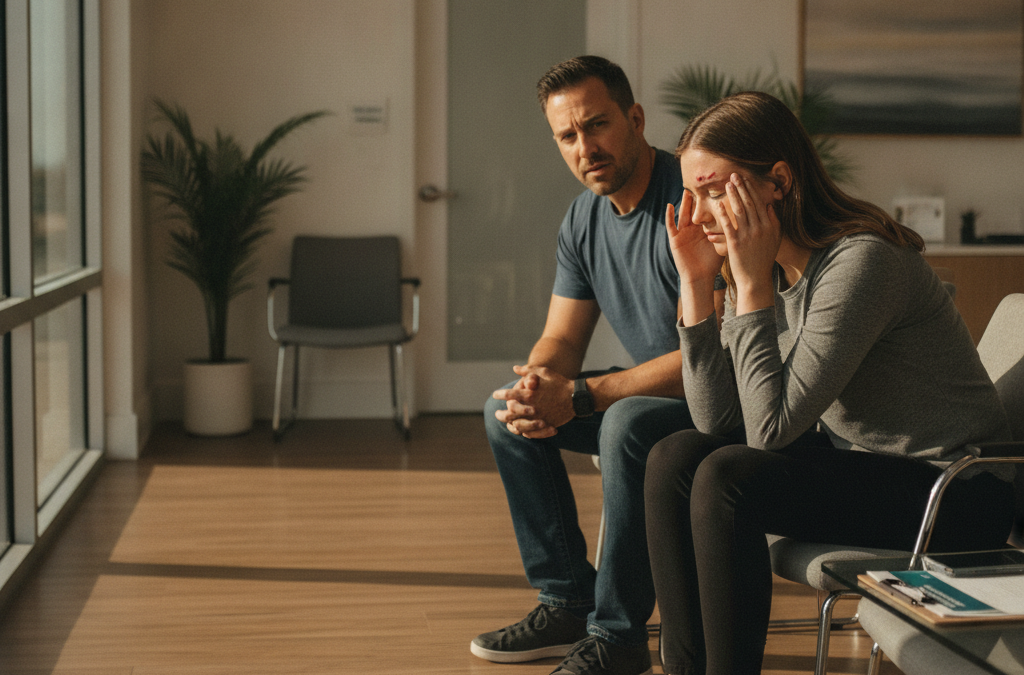
Why Do I Still Have Headaches Weeks After My Car Accident in Tampa?
If you were in a car accident in Tampa and you’re still waking up with headaches two, three, or even six weeks later — you’re not imagining it, and you’re not alone. Post-traumatic headache is one of the most common and most misunderstood consequences of a motor vehicle accident. What frustrates many patients is that they didn’t even hit their head directly. They walked away from the scene, maybe went to an urgent care, got told everything looked fine, and then spent the next month wondering why their head won’t stop pounding. The answer almost always comes down to what happened to your brain and your cervical spine during the collision — and the fact that those injuries don’t always show up on a standard ER scan.
What’s Actually Causing Your Headaches After the Accident?
There isn’t one single cause. Post-accident headaches typically fall into a few distinct categories, and correctly identifying which type you have is what determines the right treatment path.
Post-Traumatic Headache from Brain Injury
Even a relatively low-speed collision can cause your brain to shift inside your skull. You don’t need to lose consciousness. You don’t need a visible wound. When the brain experiences that kind of rapid acceleration and deceleration, the microscopic nerve fibers — called axons — can stretch or tear. This is the mechanism behind concussion and mild traumatic brain injury (TBI), and post-traumatic headache is one of its most consistent symptoms.
These headaches often feel like migraines or tension headaches, but they don’t respond well to standard over-the-counter remedies. They can be accompanied by brain fog, light sensitivity, difficulty concentrating, irritability, or disrupted sleep. If that pattern sounds familiar, what you’re experiencing deserves a proper neurological evaluation for head injury — not just more ibuprofen.
Cervicogenic Headache from Neck Injury
Whiplash is another common culprit that gets dismissed too quickly. The sudden snap of your head and neck during a rear-end or side-impact collision can strain the muscles, ligaments, and joints of the upper cervical spine. Pain from those structures can radiate directly into the back of the skull and temples — producing what’s called a cervicogenic headache, meaning it originates from the neck.
These headaches are often one-sided, made worse by certain neck movements, and sometimes accompanied by shoulder or upper back tightness. They won’t resolve with TBI-focused treatment alone. They need the spine component addressed too.
Intracranial Pressure Changes and Vascular Disruption
Less commonly, trauma can affect blood flow or cerebrospinal fluid dynamics in ways that generate persistent pressure-type headaches. This is why certain warning signs — sudden severe headache, vision changes, weakness on one side, confusion, or a headache that progressively worsens — should prompt immediate emergency evaluation. These can indicate something more serious that a specialist needs to rule out before treating the headache itself.
Why “The ER Said Everything Was Fine” Doesn’t Mean There’s Nothing Wrong
This is one of the most important things to understand, and it’s something that most competitor clinic websites in the Tampa area don’t explain clearly to patients. Emergency departments are excellent at ruling out life-threatening hemorrhage or fracture. A standard CT scan at the ER is designed to catch those critical findings. It is not designed to detect the diffuse axonal injury patterns or soft tissue damage that cause most post-accident headaches.
When a neurologist evaluates you for persistent post-traumatic headaches, they’re doing something different. They’re looking at your symptom timeline, cognitive function, sleep quality, mood changes, and when appropriate, ordering advanced neuroimaging that shows brain structure and function in much more detail. They’re connecting dots that an emergency visit isn’t designed to connect.
Tampa Bay’s high rate of motor vehicle accidents — particularly along the I-275 corridor, Veterans Expressway, and heavily trafficked routes through Hillsborough County — means neurologists here see this presentation regularly. That experience matters when it comes to recognizing subtle patterns that indicate a mild TBI or cervicogenic injury that needs structured care.
Why Timing Matters More Than You Might Think
There are two reasons early evaluation is important, and they’re both worth understanding.
The first is medical. The brain has a recovery window after trauma during which targeted interventions — whether that’s specific headache management, vestibular therapy, hyperbaric oxygen therapy, or cognitive rehabilitation — can make a meaningful difference. Waiting months before seeking evaluation doesn’t just delay relief. In some cases, it allows patterns of chronic daily headache to become entrenched in ways that are harder to unwind.
The second reason is documentation. If your accident involved another driver and you’re working with a personal injury attorney, or if you’re navigating Florida’s no-fault PIP (Personal Injury Protection) insurance system, the medical record you build in the weeks following your accident matters. Gaps in care are often used to minimize claims. A thorough evaluation that documents your symptoms, timeline, and diagnosis creates the clinical foundation that supports your case.
Patients in Brandon, Land O’ Lakes, Wesley Chapel, and Lutz who were injured in accidents often find themselves managing insurance calls while trying to figure out where to get evaluated — and not knowing that specialty neurology evaluation is accessible without necessarily going through a large hospital system first.
What a Neurological Evaluation for Post-Accident Headache Actually Involves
If you come in for an evaluation at a specialty neurology and spine clinic, here’s what you should expect the process to look like — not a rushed office visit, but a structured assessment.
- Detailed history: The mechanism of your accident, the immediate symptoms you experienced, how your headaches have changed over time, what makes them better or worse, and any associated cognitive or mood symptoms.
- Neurological examination: Assessment of reflexes, coordination, eye movement, balance, and cognitive screening — things that reveal how your nervous system is functioning, not just how you feel.
- Imaging review or referral: Your existing images are reviewed. If advanced imaging is warranted, that gets ordered. A specialist with a background in neuroimaging reads these differently than a general radiologist.
- Cervical spine assessment: Because the neck is so frequently involved in post-accident headaches, the evaluation should include the cervical spine — not just the brain.
- A treatment plan that matches what was actually found: Not a generic protocol, but a structured plan based on your specific injury pattern.
At Advanced Brain & Spine, evaluations are led by Dr. Saldin, who trained at Duke University in neurology and completed board certification in pain medicine at the University of Virginia. His subspecialty background in neuroimaging means post-accident brain injuries get read with a level of specificity that general practice can’t replicate. You can learn more about his background and approach on the about page.
Treatment Options When Headaches Don’t Resolve on Their Own
The right treatment depends on what’s driving the headaches. Options that may be relevant — individually or in combination — include:
- Targeted headache and pain management: Prescription approaches matched to the headache type, not just general migraine protocols.
- Cervical spine injections: Facet joint injections or nerve blocks can be highly effective for cervicogenic headaches that originate in the upper neck joints or nerves.
- Hyperbaric oxygen therapy (HBOT): For patients with confirmed or suspected mild TBI, hyperbaric oxygen therapy for TBI supports neurological recovery by increasing oxygen delivery to injured brain tissue. It’s one of the more underutilized tools in post-accident care, and it has a meaningful evidence base for reducing cognitive and headache symptoms after brain injury.
- Rehabilitation coordination: Vestibular therapy, cognitive rehabilitation, and physical therapy targeting the cervical spine are often part of a comprehensive plan.
Frequently Asked Questions
How long after a car accident can post-traumatic headaches last?
In many cases, post-traumatic headaches begin to improve within three months. However, a significant portion of patients — particularly those with undiagnosed mild TBI or untreated cervical injury — experience headaches that persist for six months or longer. Early evaluation and structured treatment improve recovery outcomes considerably.
Can I see a neurologist in Tampa after an accident if I only have PIP insurance?
Yes. Florida’s no-fault PIP coverage generally includes neurological evaluation and treatment for injuries sustained in motor vehicle accidents. Many specialty clinics in the Tampa area also work with patients on a letter of protection (LOP) basis, meaning treatment proceeds while a personal injury claim is resolved. Ask about your options when you call.
Do I need a referral to see a neurologist in Tampa after a car accident?
Not at Advanced Brain & Spine. Many patients come directly after an accident without a primary care referral, particularly when symptoms are present and they want answers quickly. Self-referral is straightforward — a consultation can be booked directly.
I live in Wesley Chapel or Carrollwood — is Advanced Brain & Spine accessible from those areas?
Yes. The clinic is located in Tampa on Wilsky Boulevard, which is accessible from Carrollwood, Lutz, Land O’ Lakes, and Wesley Chapel without navigating into the city core. Patients from across northwestern Hillsborough County and southern Pasco County routinely make the trip for specialty neurology care.
What if my headaches started days after the accident, not immediately?
This is extremely common and doesn’t mean the accident wasn’t the cause. Delayed onset of post-traumatic headache — sometimes appearing 24 to 72 hours after the collision — is well-documented and recognized by neurologists. It doesn’t weaken your medical case or your injury claim. It’s part of the expected pattern of how these injuries present.
You Deserve a Real Answer — Not Another “Wait and See”
Persistent headaches after a car accident in Tampa are not something to push through indefinitely. They’re a signal that something in your brain or neck was affected by the collision, and they respond far better to structured, specialist-led care than to time alone. Whether you’re two weeks out from the accident or two months out and still struggling, it’s worth getting a proper evaluation from someone who specializes in exactly this.
Advanced Brain & Spine serves patients throughout Tampa, Carrollwood, Land O’ Lakes, Lutz, Wesley Chapel, Brandon, and surrounding communities in Hillsborough and Pasco counties. If you’re ready to get clarity on what’s causing your headaches and what can actually be done about them, book a consultation today or call us at (813) 460-5670. You don’t have to keep guessing.