What Is Proprioceptive Dysfunction After a Brain Injury — and Why Are So Many Patients in Tampa and Land O’ Lakes Never Told That Their Clumsiness and Spatial Disorientation Are a Neurological Symptom?
Yes — that persistent clumsiness, that strange feeling of not quite knowing where your body is in space, or that difficulty judging distances and navigating doorways since your head injury is a real, documented neurological symptom. It’s called proprioceptive dysfunction, and it’s one of the most overlooked consequences of concussion and traumatic brain injury (TBI). If you’ve been dismissed as anxious, out of shape, or “just getting older” after a head injury, you deserve a better explanation — and a better path forward.
What Is Proprioception, and Why Does Your Brain Control It?
Proprioception is your body’s internal positioning system. Without thinking about it, your nervous system continuously tracks where your limbs are, how fast you’re moving, how much force you’re applying, and how your body is oriented relative to gravity and the space around you. This constant, unconscious feedback loop allows you to walk without looking at your feet, catch yourself when you stumble, and reach for a glass of water without misjudging the distance.
This system depends on a continuous conversation between your peripheral nerves, your spinal cord, your cerebellum, and your brain’s sensory cortex. When a head injury disrupts the neural pathways that process and integrate that information, the result isn’t just balance problems — it’s a broader breakdown in how your body understands its own position in the world. Patients often describe it as feeling disconnected from their own limbs, bumping into furniture that seems to be closer than expected, or misjudging curbs and steps. These aren’t personality quirks or signs of age. They are neurological symptoms.
The Gap Most Providers Are Missing
Here’s the hard truth: most patients who come to us after a car accident on I-275 or a sports concussion during a Tampa Bay youth league game have already been told their imaging looks normal. They’ve had an MRI or CT scan, been given a clean bill of health, and sent home with instructions to rest. And yet weeks or months later, they’re still knocking over drinks, tripping on flat surfaces, or struggling to walk through a crowded grocery store without anxiety.
What those imaging studies can’t show is the disruption to functional neural networks — specifically the pathways that integrate proprioceptive signals from the body with the brain’s spatial processing centers. Standard hospital neurology programs and general urgent care providers rarely evaluate this dimension of brain injury recovery. That’s a significant gap, and it’s one we see regularly in patients from across Hillsborough County and Pasco County who have bounced between providers without ever receiving a clear answer about why they still feel “off.”
If you’re still searching for answers after a head injury, our brain injury treatment program includes a thorough evaluation designed to identify exactly these kinds of functional deficits that standard imaging misses.
Who Is Most Affected by Proprioceptive Dysfunction After a Brain Injury?
Proprioceptive dysfunction can affect anyone who has sustained a concussion or TBI, but certain groups are particularly vulnerable — and particularly underserved by the current standard of care.
- Student and youth athletes: Tampa Bay has a highly active youth athletic community across football, soccer, wrestling, and cheerleading. A proprioceptive deficit after a sports concussion doesn’t just affect performance — it increases the risk of secondary injury, because the athlete can no longer trust the body’s positioning signals on the field.
- Motor vehicle accident survivors: High-impact collisions along the I-275 and I-4 corridors generate significant rotational forces on the brain. These forces are especially disruptive to the cerebellum and brainstem — areas that are central to proprioceptive processing.
- Older adults in Land O’ Lakes and surrounding retirement communities: Aging populations already experience some natural decline in proprioceptive acuity. A brain injury layered on top of age-related changes can create profound instability, dramatically increasing fall risk — a serious concern for the large retiree population in Pasco County.
- Patients with multiple or repeated concussions: Each injury adds cumulative disruption to these neural pathways, making recovery more complex without targeted intervention.
What Does Proprioceptive Dysfunction Actually Feel Like?
Patients rarely walk in and say “I think I have proprioceptive dysfunction.” Instead, they describe it in more frustrating, harder-to-explain terms:
- “I keep bumping into doorframes even though I can see them.”
- “I misjudge steps and curbs — I’ve almost fallen a dozen times.”
- “I feel disconnected from my legs, like they’re not quite mine.”
- “I can’t walk in the dark without grabbing a wall.”
- “I used to be athletic. Now I feel clumsy all the time.”
- “Standing in a crowded room or a moving vehicle makes me feel panicked and disoriented.”
These descriptions are clinically meaningful. They map directly onto how proprioceptive and spatial processing deficits present after neurological injury. If this sounds like your experience, the right response is not to chalk it up to anxiety or aging — it’s to pursue a proper neurological evaluation.
How Is Proprioceptive Dysfunction Evaluated and Treated?
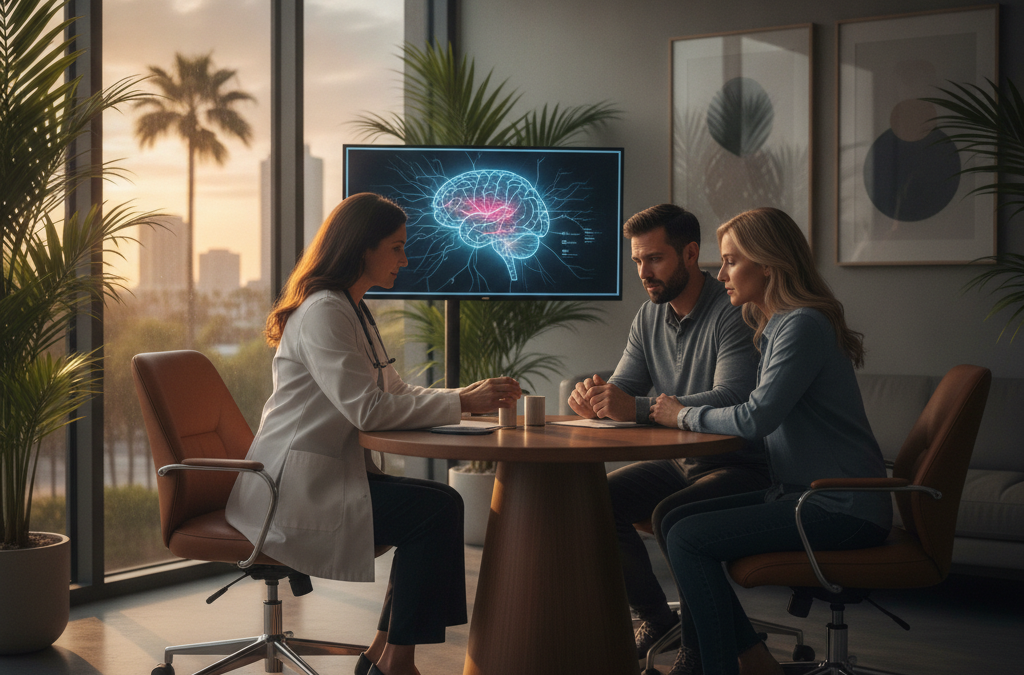
Proper evaluation begins with a comprehensive clinical assessment that goes beyond standard imaging. A specialist practice will look at how your brain and body are integrating sensory information — including balance testing, gait analysis, coordination assessments, and a detailed review of your injury history and current functional deficits.
From there, a personalized treatment plan may include targeted neurological rehabilitation, sensorimotor retraining exercises, and — for patients with significant nerve or tissue involvement — regenerative medicine approaches designed to support the brain and nervous system’s own repair processes. This is where regenerative and stem cell therapies have begun to show meaningful clinical promise for TBI recovery: not as a blanket cure, but as a tool to support neural repair in patients whose conventional rehabilitation has plateaued.
To understand whether you might be a candidate for regenerative approaches as part of your recovery, the first step is a thorough consultation. You can learn more about what that process looks like on our how it works page.
Why Proprioceptive Symptoms Are Often Mistaken for Anxiety or Depression
There’s a damaging pattern we see in patients who’ve been living with undiagnosed proprioceptive dysfunction: because the sensation of spatial disorientation and bodily disconnection is so distressing, many patients develop anxiety around movement, crowds, and unfamiliar environments. This is then treated as a primary mental health condition, and the underlying neurological cause goes unaddressed.
The emotional distress is real. But it is downstream of an unresolved neurological problem. Treating only the anxiety without addressing the proprioceptive dysfunction is like treating smoke without acknowledging the fire. Patients in this situation deserve a provider who will look at the whole clinical picture — and who won’t stop at “your scans are normal.”
Getting the Right Care in Tampa and Land O’ Lakes
If you’ve been living with unexplained clumsiness, spatial confusion, or a persistent feeling of bodily disconnection since a head injury, you don’t have to keep guessing. A specialized evaluation by a brain injury practice — not a general neurologist or urgent care clinic — is the appropriate starting point. The right practice will take your functional symptoms seriously, assess your proprioceptive and sensorimotor systems thoroughly, and build a treatment plan designed around restoring your real-world function, not just what shows up on a scan.
At Advanced Brain and Spine, we serve patients from across the Tampa Bay area, including Hillsborough County, Pasco County, Land O’ Lakes, and surrounding communities who are looking for answers — and a clear path forward — after a brain injury has changed how they move through the world.
Frequently Asked Questions
Can proprioceptive dysfunction develop after a mild concussion, or only after severe TBI?
It can develop after any level of brain injury, including what’s classified as a mild concussion. The severity of proprioceptive symptoms doesn’t always correlate with how serious the initial injury appeared. Many patients with “mild” concussions experience significant and lasting proprioceptive deficits, especially without appropriate follow-up care.
Will proprioceptive dysfunction resolve on its own over time?
For some patients, mild symptoms improve with rest and time. For others — particularly those with unresolved neuroinflammation, repeated injuries, or injuries that were not properly treated — proprioceptive dysfunction can persist or worsen without targeted intervention. Early evaluation and treatment generally produce better outcomes than waiting.
Is there a test for proprioceptive dysfunction after a brain injury?
Yes. While standard MRI and CT scans typically won’t reveal proprioceptive deficits, a clinical specialist can assess this through functional balance testing, sensorimotor coordination assessments, and other neurological evaluations. A thorough intake history that documents your day-to-day functional experience is also a critical part of the diagnostic picture.
Are there regenerative or stem cell treatment options for proprioceptive dysfunction after TBI?
Regenerative medicine approaches, including stem cell therapy, are being explored as part of comprehensive TBI recovery programs for patients whose symptoms haven’t resolved with conventional rehabilitation. These therapies aim to support nerve and tissue repair at the cellular level. Whether you’re a candidate depends on your specific injury history, symptom profile, and overall health — which is why a thorough consultation is the right starting point.
I’m in Land O’ Lakes — do I need to travel to a major hospital system in Tampa for this kind of evaluation?
Not necessarily. Large hospital neurology departments in the Tampa Bay area are well-equipped for acute care, but specialized brain injury evaluation — including functional and proprioceptive assessment — is often better suited to a dedicated specialist practice. Advanced Brain and Spine serves patients across the Hillsborough and Pasco County area, including Land O’ Lakes, and offers consultations specifically designed for patients recovering from concussion and TBI.
You Deserve an Explanation — and a Real Plan
Proprioceptive dysfunction after a brain injury is real, it is measurable, and it is treatable. If your current provider hasn’t discussed this possibility with you, it’s not because it doesn’t exist — it’s because most standard care pathways don’t look for it. You deserve a specialist who will. Schedule a free consultation with Advanced Brain and Spine and take the first step toward understanding what’s actually happening in your nervous system — and what can be done about it.