
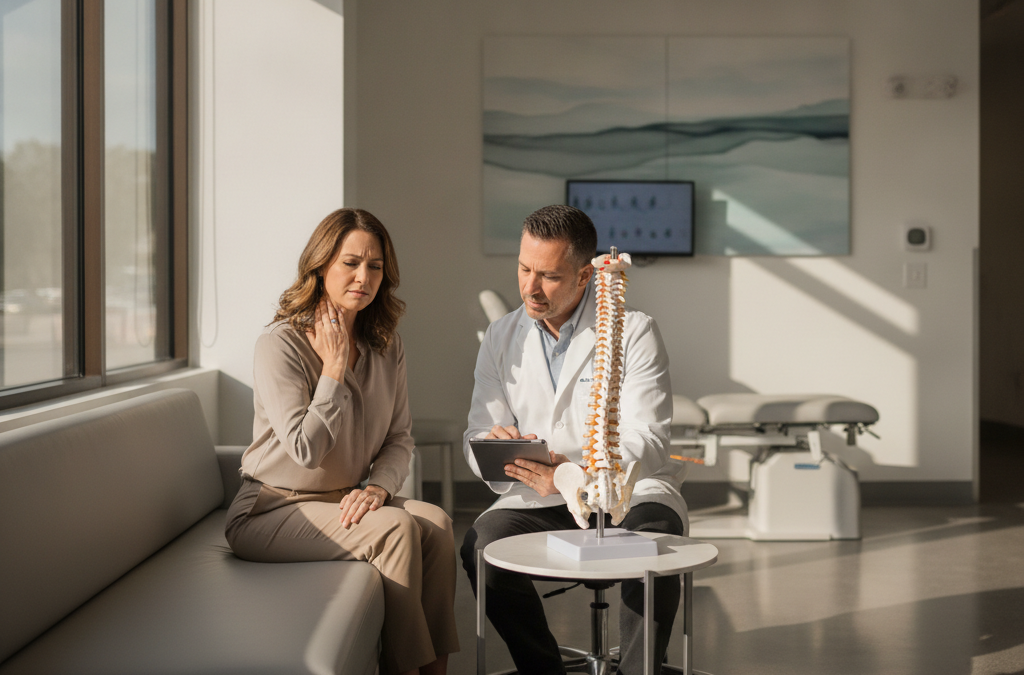
What Is Cervicogenic Dizziness — and Why Are So Many Patients in Clearwater and St. Petersburg Told Their Neck Pain and Vertigo Are Two Separate Problems When They’re Actually One?
If you’ve been dealing with dizziness and neck pain since a car accident or a fall, and two or three different doctors have sent you in two or three different directions, you’re not alone — and you may not be getting the full picture. Cervicogenic dizziness is a real, diagnosable condition in which dysfunction in the cervical spine — the bones, joints, muscles, and nerves of your neck — directly causes dizziness, a sense of unsteadiness, or spatial disorientation. It is not a balance disorder. It is not anxiety. It is a mechanical and neurological problem with a structural source, and it’s one of the most consistently underdiagnosed conditions we see in patients across Clearwater, St. Petersburg, Tampa, and throughout the surrounding Pinellas and Hillsborough County communities.
Why Your Neck Can Make You Dizzy — and Why That Connection Gets Missed
The cervical spine isn’t just a stack of bones supporting your head. It’s packed with specialized sensory receptors — called proprioceptors — that continuously send signals to your brain about where your head is in space. These signals work in close coordination with your inner ear and your visual system to keep you balanced and oriented. When the cervical spine is injured, whether from the sharp force of a rear-end collision on I-275, a hard fall on a wet floor in St. Petersburg, or even a sports impact, those sensory signals can become distorted or misfiring. Your brain receives conflicting information. The result is dizziness that feels real, persistent, and deeply disruptive — because it is all of those things.
The reason this gets missed so often is structural: most healthcare systems divide symptoms into departments. Your neck goes to orthopedics or a spine clinic. Your dizziness goes to an ENT or a neurologist. Neither specialist is necessarily looking at how those two systems are interacting. So you end up with a diagnosis that doesn’t explain your full picture, treatments that address half the problem, and a frustrating sense that no one is connecting the dots.
What Does Cervicogenic Dizziness Actually Feel Like?
Patients describe it in different ways, which is part of why it gets confused with other conditions. Some of the most common patterns include:
- Dizziness or lightheadedness that worsens with neck movement — turning your head, looking up or down, or driving
- A feeling of being slightly “off” or unsteady when walking, even on flat ground
- Neck pain or stiffness that accompanies or precedes episodes of dizziness
- Headaches that radiate from the base of the skull upward
- Difficulty concentrating or a foggy feeling during or after dizzy episodes
- Symptoms that are worse after sitting at a desk or driving for extended periods
Crucially, cervicogenic dizziness is typically not spinning vertigo — the room-spinning sensation most people associate with inner ear problems like BPPV. If your dizziness is more of a floating, rocking, or off-balance feeling tied to neck position or movement, the cervical spine is a highly plausible source worth evaluating carefully.
How Cervicogenic Dizziness Is Diagnosed — and Why This Step Is So Often Skipped
There is no single definitive test for cervicogenic dizziness, which is part of why it gets overlooked. Diagnosis requires a clinician who understands both the neurological and spinal dimensions of the problem — someone who can integrate your history, your symptom pattern, imaging of the cervical spine, and a structured neurological examination to rule out other causes and identify the cervical spine as the likely driver.
A thorough evaluation typically includes a detailed review of how and when your symptoms began, a physical examination of cervical spine range of motion and tenderness, assessment of your gait and balance, and imaging — often MRI — to identify any structural injuries to the discs, joints, or soft tissue of the neck. Neuroimaging is particularly important in post-accident cases, where injuries may be subtle but functionally significant. At Advanced Brain & Spine, Dr. Saldin brings Duke-trained neurology and University of Virginia pain medicine board certification to this kind of integrated evaluation — looking at both the neurological and structural picture together rather than handing patients off between departments.
The Gap in Local Care That Leaves Patients Cycling Through Appointments
After reviewing how local competitors across the Tampa Bay area approach dizziness and cervical spine conditions, one gap stands out clearly: very few clinics are explicitly addressing cervicogenic dizziness as a unified diagnosis. Most sites either discuss neck pain or discuss balance and dizziness — rarely both together, and almost never in the context of how the cervical spine’s proprioceptive system drives dizziness after trauma. Patients searching for answers about why their neck pain and vertigo seem connected are largely finding fragmented information that doesn’t validate their experience or point them toward integrated care.
This matters because patients in Clearwater and St. Petersburg — communities with high traffic volumes along US-19 and I-275 and a significant rate of motor vehicle accident claims throughout Pinellas County — are often reaching out urgently after accidents, looking for someone who will take their full symptom picture seriously. When a clinic only talks about one half of the problem, that patient is likely to keep searching, or worse, accept an incomplete treatment plan and plateau unnecessarily.
How Cervicogenic Dizziness Is Treated
Treatment depends on what’s driving the cervical dysfunction. When the source is inflammation or injury to the facet joints — the small paired joints at the back of the cervical spine that are particularly vulnerable in whiplash-type injuries — targeted interventions can reduce the pain signal and calm the disrupted proprioceptive feedback. These may include cervical facet injections to quiet local inflammation, or in cases where pain has become more persistent, a facet joint radiofrequency ablation procedure to interrupt the pain pathway more durably.
For patients whose cervical injuries involve disc damage or soft tissue disruption, regenerative approaches like stem cell therapy for the cervical spine may support structural healing in ways that anti-inflammatory measures alone cannot. The goal is to address the underlying injury driving the sensory misfiring — not just manage the dizziness as a symptom in isolation.
Physical therapy targeting cervical proprioception and gaze stabilization is often part of a comprehensive plan. And for patients whose injuries have a broader neurological dimension — particularly those involving a concurrent head injury — additional evaluation and treatment may be warranted to address both the cervical and central components of their symptoms.
Why Prompt Evaluation Matters — Especially After an Accident
If your dizziness and neck pain followed a motor vehicle accident or a slip-and-fall injury, there are compelling reasons not to wait. Florida’s no-fault auto insurance (PIP) system requires that you seek medical evaluation within 14 days of an accident to preserve your insurance benefits. Beyond the insurance timeline, early documentation of a neurological or spinal injury matters for your care and for any potential injury claim. Patients in Brandon, Wesley Chapel, and throughout the Tampa Bay area who delay evaluation often find that the medical record becomes harder to connect to the accident — which affects both their treatment access and their legal standing if they’re working with an attorney on a letter of protection (LOP) basis.
At Advanced Brain & Spine, we work with patients across the full range of insurance situations, including self-pay and attorney-referred cases, because we believe that access to thorough, specialized care shouldn’t be contingent on your coverage situation. Our spine care services are structured to evaluate and treat the full injury picture — not just the part that fits neatly into a billing category.
Frequently Asked Questions
Can a car accident in Clearwater cause both neck pain and dizziness at the same time?
Yes. The force of a rear-end or side-impact collision can injure the cervical spine’s joints, discs, and soft tissues, disrupting the proprioceptive signals that help your brain track your head’s position. The result is often a combination of neck pain and dizziness that worsen together — because they come from the same structural injury.
How is cervicogenic dizziness different from BPPV (inner ear vertigo)?
BPPV involves displaced calcium crystals in the inner ear and typically causes brief, intense spinning episodes triggered by specific head positions. Cervicogenic dizziness is usually more of a chronic, low-grade unsteadiness or floating sensation tied to neck movement and posture. A trained clinician can distinguish between them through history and physical examination, and in some cases both conditions can exist simultaneously after a trauma.
Will imaging like an MRI show cervicogenic dizziness?
MRI won’t show the dizziness itself, but it can identify the structural injuries — herniated discs, facet joint damage, soft tissue swelling — that are causing it. Neuroimaging is an important part of the diagnostic process, particularly in post-accident cases where subtle injuries may not be visible on X-ray.
Does Florida’s PIP insurance cover evaluation and treatment for cervicogenic dizziness after an accident?
Generally, Florida’s personal injury protection (PIP) insurance covers medically necessary evaluation and treatment following a motor vehicle accident, including neurological and spine-related care. However, coverage specifics vary by policy, and you must seek care within 14 days of the accident to qualify. We recommend calling your provider — or contacting our office — to understand your options before delaying care.
How long does recovery from cervicogenic dizziness take?
Recovery timelines vary significantly based on the severity of the underlying cervical injury and how promptly treatment begins. Some patients see meaningful improvement within weeks of targeted treatment. Others with more significant structural damage may follow a longer recovery course. An individualized evaluation is the only way to get a realistic sense of your specific timeline.
You Deserve a Complete Diagnosis — Not Two Half-Answers
If your neck pain and dizziness started after an accident or injury and no one has evaluated them together as a single, connected problem, it’s time to change that. At Advanced Brain & Spine in Tampa, we specialize in exactly this kind of integrated neurological and spine evaluation — finding the real source of your symptoms rather than triaging them into separate referrals. Patients come to us from throughout the Tampa Bay area, including Clearwater, St. Petersburg, and Pinellas County, because they’re ready for an answer that actually fits their experience.
Contact our team today to schedule a consultation. We’re here to listen, evaluate thoroughly, and build a treatment plan that addresses the whole problem — not just the part that’s easiest to explain. Reach out to Advanced Brain & Spine here or call us at (813) 460-5670.